Join our community and be part of the conversation.
To subscribe, simply enter your email address on our website or click the subscribe button below. Don't worry, we respect your privacy and won't spam your inbox. Your information is safe with us.
KPMG executive directors Woon Tai Hai and Dr. Chin Yoong Kheong provided the second report, Malaysian Economic and Information Technology Outlook in the PIKOM Strategic Review 2012/2013.
“We expect the national economy to grow at an average of 5% in 2012 and to remain resilient against the global impact of the prolonged debt crisis in the Eurozone,” they said.
Malaysia is relatively immune to the Eurozone problems since its exports to its its Asian neighbours accounted for 64.9% of its total exports during the first quarter of 2012, compared to 9.1% to European nations, while total imports from Asian countries accounted for 65.7% of total imports compared to 10.3% from the European Union.
Despite a challenging external economic environment, Malaysia’s positive economic outlook in 2012 is due to strong domestic demand attributed by a positive and growing GDP contribution by the agriculture, construction, manufacturing and services sectors respectively, while only growth in the mining & quarrying sector was negative.
“The growth of the sub-sectors is also likely to have spillover effects on ICT,” they added.
Private consumption is also expected to rise, following the upward salary revision for public service employees, the one-off financial assistance to low and middle-income groups – i.e. BR1M, and the introduction of a minimum wage, while low borrowing costs for businesses and households is expected to increase consumption and investments. Also, Malaysia inflation rate has been falling steadily from 2.7% in January to 1.7% in May, 2012, the base lending rate declined slightly from 6.54% in May 2011 to 6.53% in 2012.
Private sector investments are expected to increase due to the implementation of mega projects such as the mass rapid transit (MRT) and investments in the regional development corridors. In 2012, Iskandar Malaysia alone is expected to attract RM64.38 billion in investments.
Malaysia’s 25% corporate tax rate is among the lowest in the region besides Singapore and Laos, and on par with Vietnam, while SMEs are poised to contribute significantly to the national economy in 2012. In 2012, SMEs accounted for 32% to the GDP, 32% of total exports and 56% of employment, and 87% of SMEs are in the services sector.
However, while the government recognises that SMEs can raise the GDP contribution of the service sector from 54% in 2011 to 65% in 2012, this can only be realised if they are receptive to changes and get rid of obsolete management skills and work processes, and adopt ICT to enhance their operational efficiencies.
They also cited several the challenges facing Malaysia’s economy, including risk aversion among potential investors due to the shaky world economic performance; that any slackening of domestic demand due to the Economic Transformation Programme (ETP), Government Transformation Programme (GTP), Digital Transformation programme (DTP), Rural Transformation programme (RTP) and Political Transformation Programme (PTP); government efforts to reduce the financial deficit in 2012 may dampen public expenditure and investment unless, unless it can be achieved through revenue increasing and cost reduction strategies; fluctuation in oil and commodity prices in the world market is bound to lead to higher prices for consumers and can cause structural imbalances in market liquidity leading to higher inflation and lending rates, while a massive outflow affecting foreign exchange rates can hurt export and import earnings.
Workforce quality An over dependence on low-skilled foreign workers may not benefit Malaysia’s economy in the long term, unless efforts are made to increase workforce quality through infusion of the necessary technological capacity.
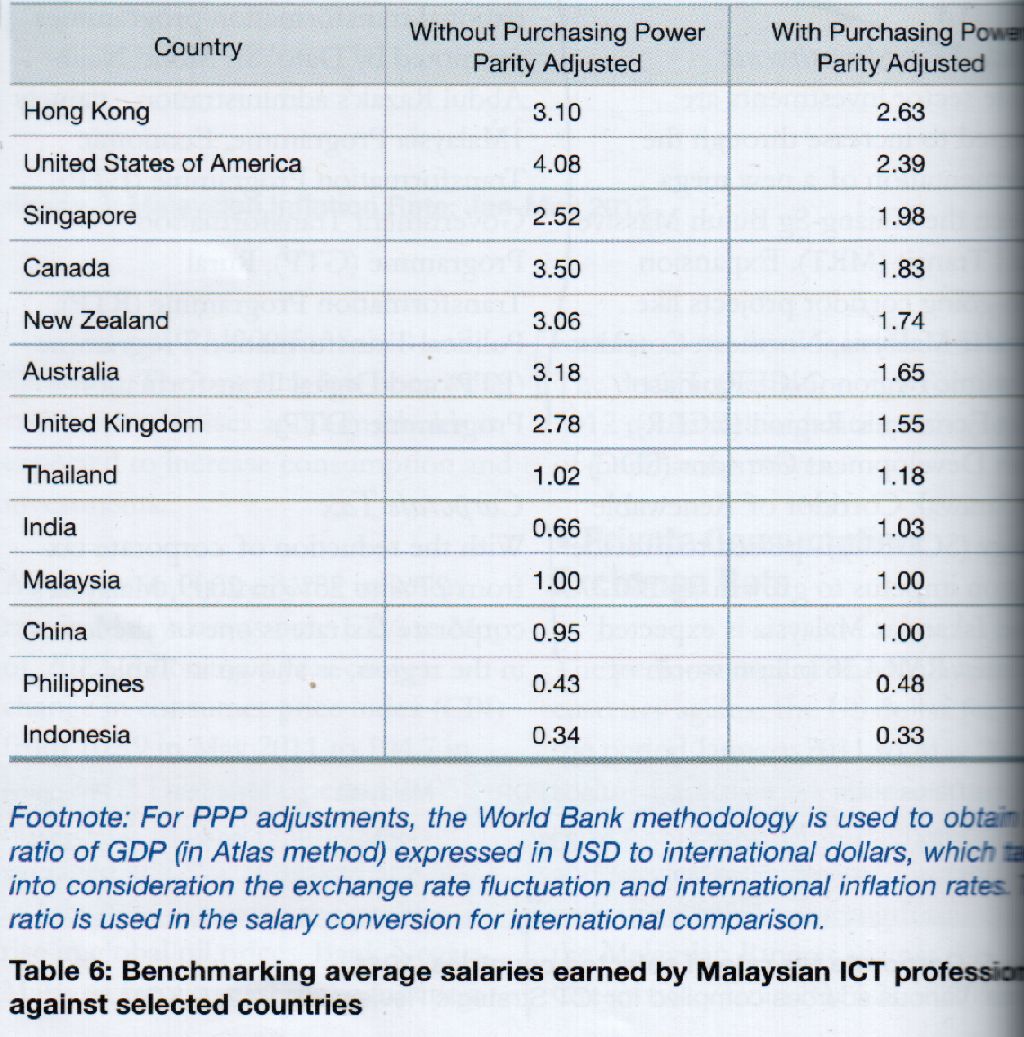
Also, the migration of Malaysian talent over the past 20 years, to neighbouring countries and English-speaking countries which pay more on average, including for ICT professionals does not help retain required talent.
In absolute terms the U.S. paid 4.08 times more than Malaysia, followed by Canada (3.5 X), Australia (3.18 X), Hong Kong (3.1 X), New Zealand (3.06 X), the U.K. (2.78 X), Singapore (2.52 X), and Thailand (1.02 X).
In purchasing power parity (PPP) terms, Hong Kong topped the list at 2.63 X, the U.S. (2.39 X), Singapore (1.98 X), Canada (1.83 X), New Zealand (1.74 X), Australia (1.65 X), the U.K. (1.55 X), Thailand (1.18 X) and India (1.03 X), while China was on par with Malaysia in PPP terms.
ICT outlook Global spending on ICT altogether grew by 2.5% from US$3.66 trillion in 2011 to an expected US$3.75 trillion in 2012, though growth was slower compared to a 6.8% increase from 2010 to 2011.
Spending on telecommunications equipment is expected to grow the fastest at 6.9% from 2011 to 2012 and to reach US$742 billion this year. It’s followed by enterprise software (5%, US$280 billion), computer hardware (4.3%, US$421 billion), IT services (1.3%, US$856 billion) and telecommunication services (1%, US$1,72 trillion).
PIKOM predicts that IT spending in Malaysia to grow by at least 12% in 2012, while IDC expects domestic IT spending to reach US$8.2 billion (RM24.6 billion) by the end of 2012.