Join our community and be part of the conversation.
To subscribe, simply enter your email address on our website or click the subscribe button below. Don't worry, we respect your privacy and won't spam your inbox. Your information is safe with us.
The opening day of WCIT was dedicated to assuaging fears that the International Telecommunications Union has an agenda to supplant the current multi-stakeholder model that governs the Internet, in a sign that a US-led campaign against proposed changes to international comms regulations is having an effect.
In a richly symbolic move, Fadi Chehadé, the CEO of the Internet Corporation of for Assigned Names and Numbers (ICANN) – the Californian-based authority over Internet addressing—spoke at the opening ceremony of WCIT yesterday. Chehadé, an American citizen who grew up in Egypt, gave part of his address in Arabic as part of a clear pitch to Arab nations who dislike what they see as the US-centric nature of ICANN and would prefer an ITU-style organisation to assume its powers. Following Chehadé, ITU secretary general Hamadoun Toure used much of his address to downplay concerns that WCIT had an agenda to stifle the Internet, saying he was looking for a win-win outcome. He explicitly rejected the notion that the WCIT might force a majority vote verdict on the world’s telecom industry, stating “the three keys to the success of this conference are consensus, consensus and consensus.” “I look forward to seeing how the spirit of consensus, the spirit of compromise, and the spirit of multi-stakeholderism (sic) will come together to deliver that win-win solution – in the true ITU tradition.” In a later press conference, Australian communications minister Stephen Conroy—one of the most senior elected politicians in attendance— backed up the theme of consensus, stating that he supported Toure’s comments. He said that one of the key points behind the success of the international telecommunications regulations, last ratified in 1988, wasthat they were not overly prescriptive. The US campaign—charging that nations such as Russia, the Arab states and some African countries have an agenda to place the Internet under strong government control and introduce a new charging regime—has clearly spooked the ITU. A leaked document from the organisation’s September leadership retreat pinged what it described as a US campaign against WCIT. “Early media coverage was driven by a well-financed and well-organized campaign originating in the USA. The purpose of that campaign was to discredit the ITU and WCIT, so as to minimise the chances that the new regulations could affect the existing flow of funds for Internet traffic. But the campaign often, and misleadingly, refers to proposals to “control the Internet”, “restrict access”, and “impose censorship”, the briefing paper said. Challenging the critics In recent days, ITU PR operatives Toby Johnson and Paul Conneally have also aggressively taken to challenging US critics of WCIT on Twitter and have linked approvingly to commentary that criticises the US position as a thinly-veiled attempt to protect the economic interests of major American companies such as Google. The ITU WCIT website is also currently highlighting video and commentary from Australian industry advocate Paul Budde, where he writes “despite the many sensational press articles that have preceded this conference the mood is optimistic. All those attending the conference are very well-informed and they are ignoring the conspiracy theories that many uninformed members of the press have been pumping out.” However, the public relations campaign by the ITU and its supporters against the so-called “conspiracy theories” coming from the US has already been heavily criticised as misleading in its own right. US analyst Dean Bubley says the WCIT proposals backed by European telcos and some African & Arab nations to introduce a “sender-pays” billing model for Internet traffic is deserving of criticism. “Not only is it unworkable & badly defined, but it risks severe unintended consequences which could a) create risk of worse performance for the Internet in developing countries, and b) creates a moral hazard risking the current way the Internet provides welfare & innovation to billions,” he wrote on a Huffington Post. And Google VP and “father of the Internet” Vint Cerf said in a comment on an ITU blog that “the US industry is supporting multi-stakeholder enhanced cooperation. What do you think ICANN, regional Internet registries, IGF, Internet Society and W3C are all about? Google has been a major sponsor of multi-stakeholder processes and will continue to be in the future. The absence of direct, non-governmental actors in the ITU processes is a glaring deficiency.” The opening plenary session last night was mainly taken up with procedural matters such as adoption of the planned agenda and the election of the conference chair. Local UAE telecom regulatory director general Mohamed Al Ghanim was elected unopposed to lead the event. Comment by Dave Burstein in Dubai Finding the truth in Dubai will be hard. Diplomats are like politicians; believe nothing. Almost surely, the Americans have already won two months ago the major battles on security, control, and governance. The Australian proposal called for making everything in the treaty so general it was meaningless. That looks like the final outcome. The vast propaganda campaign feels like overkill; the scary Russian proposals by all accounts have no chance of getting through.
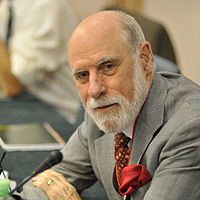
Vinton Cerf – concerned ‘parent’
But Google VP and father of the Internet Vint Cerf is here, fighting hard alongside the 115 member U.S. delegation. He’s acting as though major actions remain possible. Vint is one of the best; maybe he knows something I don’t. Perhaps the Russians or Chinese are planning a big surprise. After all, by most counts the Americans and their allies (Australia, Japan, Europe) have only a minority of votes. Secretary general Hamadoun Toure has stated a dozen times it will be decided by consensus and not by votes, giving the Americans a veto they fully intend to use. I’m expecting far more rhetoric than substance, but I’ll be all over Dubai with ears open. The most reasonable explanation of the massive U.S. “hearts and minds” campaign is they want to win so decisively no one will challenge the U.S./multi-stakeholder model for years. That’s unlikely. China now has almost twice as many Internet users as the U.S. and even Africa will have more in a few years as hundreds of millions of Africans upgrade to smartphones. The U.S. leadership has been mostly benevolent, but the rest of the world wants a piece of the action. – www.commsday.com
Cat Yong is Editor-in-Chief of Enterprise IT News, a regional news website which began in Malaysia circa 2011. A common theme in all of her work - opinions, analysis, features and more - is how technology and innovation drives business and outcomes.
A career tech journalist for 22 years, her work has evolved to also encompass narratives of tech powering human potential.