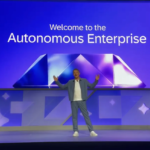


Field CTO at IBM Apptio, Matt Pinter, who has been advising organisations on cloud and AI financial management, said the shift in focus from cloud to AI is already reshaping how companies think about value. “I think cloud cost is still relevant, but there’s definitely been a very dramatic shift from cloud towards AI over the past six months,” he said. “AI spend is going to be at the top of every CFO’s mind very very soon.”
If it isn’t already.
The first step to meaningful AI ROI, Matt pointed out, is visibility. Without consolidated data on where AI dollars are going, finance and technology leaders are flying blind. Apptio begins with FinOps-style tracking – pulling token usage and model costs from hyperscalers and AI providers – the goal is to give organisations a baseline view. “We’ve also taken that solution and we’ve started to build integrations to Anthropic, to OpenAI, to Cursor, to be able to bring in the spend from some of those solutions as well,” Matt said.

This effort can enable basic controls – token monitoring, anomaly detection, and forecasting that can stop runaway costs.
But visibility alone doesn’t answer the tougher question – did the AI investment create measurable business value?
Matt cautioned that AI “tends to break the traditional ROI model,” meaning metrics that worked for prior tech waves like cloud computing are often insufficient.
Companies must adopt a multi-dimensional measurement approach – what Matt described as a “golden triangle” of metrics: cost, operational velocity and customer satisfaction. “You’ve got to look at all of them,” he said. “There’s kind of this golden triangle, if you will, where ideally you want to look at cost… you want to make sure that cost aligns with an increase in some type of unit like velocity.. and you also need to track the CSAT (customer satisfaction) score.”
To connect AI projects to commercial outcomes, Matt recommends moving from siloed proof-of-concepts to an IT Financial Management (ITFM) view that ties AI agents to the business services they support. ITFM lets organisations calculate a more complete total cost of ownership that factors in labour, networking and storage – and then compare pre- and post-deployment baselines.
Oftentimes it’s difficult for organisations to first off agree on how they want to measure it, and second off start to source that data, bring it all together, and create meaningful dashboards…
Matt Pinter
“If you put this AI platform in place, how has it moved your unit costs? Has it increased revenue? Has it decreased the spend in a particular area?” he shared examples of questions that could be answered with ITFM.
This approach lets CIOs show the CFO not just what was spent, but what the business gained.
Practical levers for improving AI ROI
Matt points to cost savings from reviewing model choice, while more mature organisations are beginning to explore token economics. Many organisations default to the most expensive models even when cheaper alternatives would deliver comparable outcomes. Showing the cost-performance tradeoffs can quickly unlock savings.
Also, controls like allocating monthly token budgets to teams and adjusting them based on demonstrated efficiency can create internal incentives for smarter usage. “One of the things they get is maybe 100,000 tokens to use for the month, and that’s their allotment,” Matt explained. “If developers want to use AI, then they need to be efficient with it.”
That said, Matt warned that the measurement challenge is organisational as well as technical. Companies often struggle to agree on what success looks like and to bring together the data needed to track it. “Oftentimes it’s difficult for organisations to first off agree on how they want to measure it, and second off start to source that data, bring it all together, and create meaningful dashboards…”
Closing that gap also requires CIOs to translate technical metrics into business language CFOs and CEOs can act on.
Triaging AI experiments
The payoff of a common cost-and-value framework is clear. Organisations can triage the hundreds of AI experiments that never reach production, double down on initiatives that reduce unit costs or increase throughput, and reallocate funds from low-value pilots into strategic deployments.
“First off, being able to consolidate all that and say, ‘Hey, did you know you’ve got 50 different AI initiatives running in your organisation? Here are some ones that are driving a high amount of cost. Are they producing value? Are they something you want to look at promoting, or should you just kill them?'” Matt said.
Most of the organisations that I speak with, it’s a little bit more aspirational. They certainly want to do it, but they’re not there quite yet.
Matt Pinter
For boards and executive teams, the path to AI ROI will be paved not by raw adoption alone, but by disciplined measurement, cross-function alignment, and continuous cost-to-value analysis.
Explainable AI investment
Organisations want to measure AI usage and value more systematically – bringing costs and token consumption together, then comparing them with outcomes such as developer productivity or business-unit costs. More mature organisations may also allocate tokens based on teams’ efficiency and results.
As Matt put it, “Most of the organisations that I speak with, it’s a little bit more aspirational. They certainly want to do it, but they’re not there quite yet.”
The effort extends beyond technology teams. Matt said CIOs need to explain AI investments in terms CFOs and CEOs can relate to – such as a lower unit cost or increased revenue – rather than technical infrastructure alone.
Frameworks such as Technology Business Management (TBM) taxonomy can help connect technology spending with business priorities, he said.