Join our community and be part of the conversation.
To subscribe, simply enter your email address on our website or click the subscribe button below. Don't worry, we respect your privacy and won't spam your inbox. Your information is safe with us.
Standard Chartered rebuilds its tech foundations to scale AI safely
Over the past year, Standard Chartered has been rebuilding the technology underpinning its banking services around a standardised private cloud, while modernising its core banking, payments and data platforms.
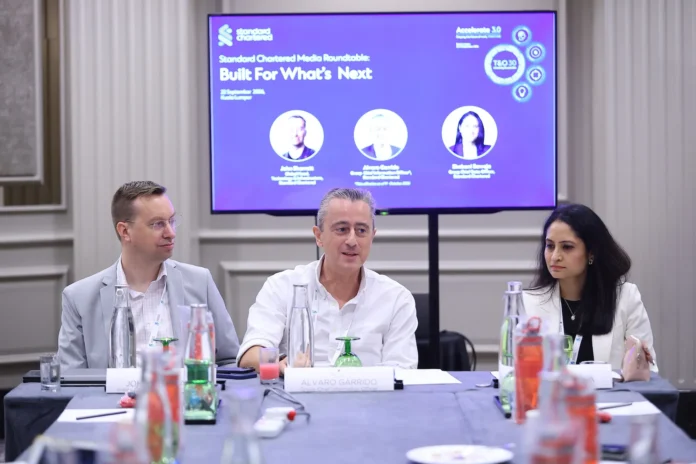
At a recent Standard Chartered media briefing in Kuala Lumpur, senior technology leaders outlined how the bank is building the foundations to scale AI while maintaining resilience across its global operations.
Alvaro Garrido, who will become Standard Chartered’s group CIO on 1 October 2026, said, “We have to spend a substantial amount of time fixing the foundations. It’s been a year of experimentation. It’s been a year of learning.”
Alvaro Garrido
Having undergone a pivot, now the financial services institution has landed upon “controls, governance, and guardrails to make sure we deploy AI in a safe way.”
“Foundations in terms of control, foundations in terms of data is fundamental. It’s always been the core of a big technology shop like ours, but now it is becoming absolutely foundational to how AI is going to operate and interoperate and connect the business process of the bank,” Alvaro said.
Over the past year, Standard Chartered has been rebuilding the technology underpinning its banking services around a standardised private cloud, while modernising its core banking, payments and data platforms.
Data and control
The bank is building a global data platform and embedding controls earlier in the development process.
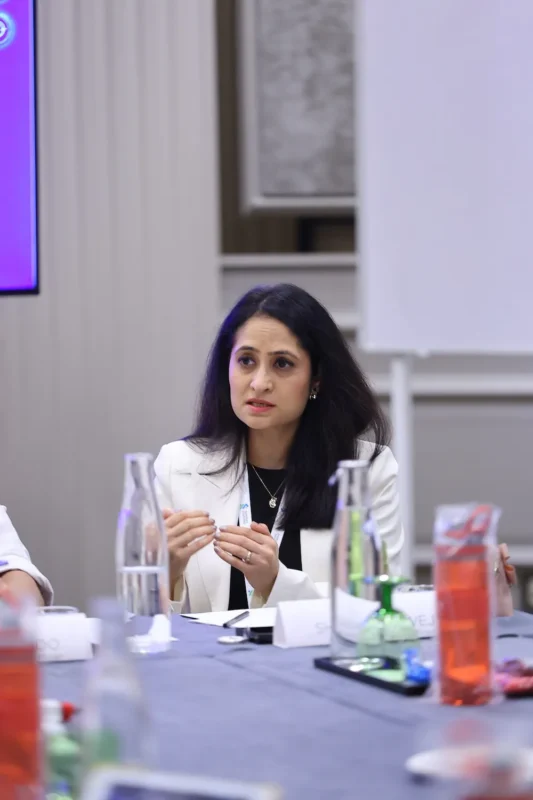
According to group chief data officer Shebani Baweja, the platform forms part of a broader data supply chain and is expected to be completed in the first half of 2028. The initiative aims to create a single source of truth by bringing together data from 150 disconnected systems, beginning with regulatory, financial and non-financial reporting.
We have to spend a substantial amount of time fixing the foundations. It’s been a year of experimentation. It’s been a year of learning.
Alvaro Garrido
Shebani described an approach that combines the centralised platform with federated data. She also discussed “shifting left” – codifying standards and policies, then building data controls into design and development.
Shebani Baweja
“Thinking about how we do data governance is becoming fundamentally important – evolving it from being looked at as a control mechanism to something that is seen as an enabler of innovation. And I think that shift is fundamental.”
Scaling with simplicity
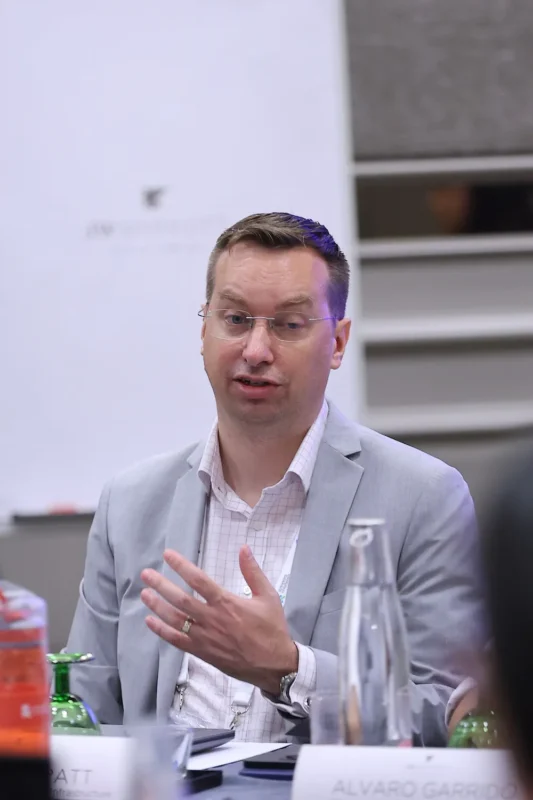
According to John Sharratt, global head of technology and infrastructure, Standard Chartered has accumulated multiple generations of infrastructure over its 170-year history. To simplify and standardise its technology estate, the bank has made an intentional shift towards software-defined platforms.
The new private-cloud design also uses less power, leaving five kilowatts of spare capacity in existing server racks for GPUs. An estimated 500 GPUs are expected to support the bank’s hybrid AI strategy, which combines AI workloads running locally on standard GPU servers with cloud-served frontier models.
“And that’s how we’re going to get scale on the tokenomics discussion,” John said.
He said the bank had deployed 300,000 virtual machines (VMs) on the new architecture, with about 50,000 primarily running in its Hong Kong and Singapore data centres. A smaller footprint has been installed in the UK.
“We’re 30- to 40-percent down on power consumption on our new architecture, even though we’ve got more virtual machines (VMs), more things we’re hosting,” John said. He added that application migrations are due to begin in 2027.