

A future where there are more AI agents than human employees is very real and an open burning question remains for enterprises – how will agentic workloads be governed like employees, and how will the platform maintain security and controls as models change rapidly? Chad Whalen, F5’s chief revenue officer has pointed to models potentially changing as frequently as every week.
Indosat Ooredoo Hutchison, or Indosat’s CEO himself, Vikram Sinha, shared that he currently runs a company of 4,000 employees. “I was asking my chief of HR and my board, that if you look at this company in 2028, we will have (hypothetically) 5,000 employees, but I’ll have 25,000 agents. How will these agents work? They have to be treated like an employee. They can’t go rogue.”
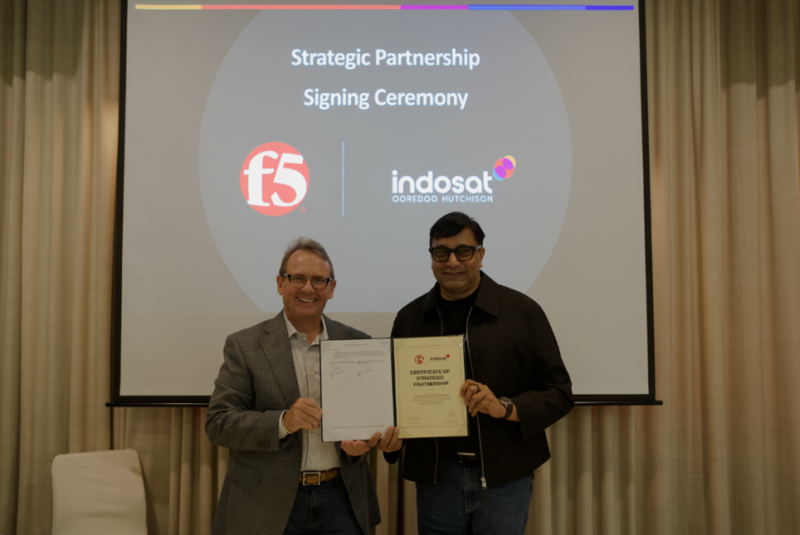
He shared this during the launch of the Intelligence Suite, a ‘token factory’ platform that Indonesia’s second largest telco co-created with F5. Vikram also added that Indosat together with partners like F5 were trying to govern potentially rogue agents.
A bridge to intelligence
Singaporean telco Singtel has launched a similar token-as-a-service platform via its sovereign cloud business, RE:AI, that has capability to route AI workloads to the most suitable AI models.
Indosat’s chief TechCo transformation and procurement officer, Vishal Gupta, quickly distinguished the product Indosat has launched as being a layer that provides flexibility, governance, transparency (of tokens consumed), and even sovereignty of control. “So, you can control intelligence on this platform through your own racks, through your own meters.”
He said that with F5 securing half of all web applications globally, it means that “this (platform) is not just an orchestrator of models; it’s a place where people will be able to connect to intelligence the way they want.”
In a bid to create for everybody to gain access to this intelligence, Indosat is starting with three distinct customer categories that each have tailored pricing structures.
The first is model builders – Indosat customer Moonshot AI that created the Kimi large language model is capable of using up to 200 trillion tokens a month.
Second is enterprise customers who require cost governance and security with simplicity and transparency wrapped around, while the third category is B2C customers which Indosat aims to offer productive and useful AI tools in an accessible format.
Vishal commented, “Very important is (that) all sizes can be served on the same platform.”
Governing AI agents
F5’s chief revenue officer Chad Whalen described F5’s approach as making AI “trusted” and securing it with observability, model testing, and guardrails.
Shadow AI, for example. “(This) is a huge thing people need to get custody of,” asking pertinent questions like, “What’s happening? Where is it happening? What’s the governance?”
He described F5’s capabilities as identifying model risks through red team testing and applying guardrails as models change on a weekly frequency.
For AI agents, he emphasised establishing agent identity, knowing what agents are doing, and setting policy controls and a “golden config” to govern their behavior. He also highlighted ongoing observability and policy enforcement, with remediation in real time to address threats as they emerge.
With F5 being the enforcement point for applications and APIs, the company finds itself in this AI age, naturally extending that enforcement point to AI inference and agentic traffic.