


AI-powered laptops could help enterprises reduce routine work and process more data locally. As AI assistants move from generating responses to carrying out tasks, however, businesses will also need to control what those systems are allowed to do.

ASUS sees AI laptops working alongside cloud infrastructure, rather than replacing it. The company recently launched the ExpertBook Ultra, equipped with its MyExpert suite, an on-device AI platform with no mandatory subscriptions.
“We believe AI-powered laptops will evolve beyond being simply smarter endpoints,” said Rex Lee, ASUS corporate vice president and APAC commercial general manager of its System Business Group.
In this distributed model, cloud infrastructure supports large-scale training and enterprise-wide workloads, while devices handle real-time inference, personalisation and everyday productivity.
“This helps enterprises better balance performance, cost, privacy, and security,” Rex said.
From assistance to action
ASUS identified transcription, summarisation, translation, intelligent search and content creation as areas where AI could reduce administrative work. Beyond these functions, Lee sees scope for AI to take a more active role in completing tasks.
We believe AI-powered laptops will evolve beyond being simply smarter endpoints.
Rex Lee
“We also see strong potential for agentic AI platforms such as Zenni Claw to automate routine workflows and help professionals complete tasks more efficiently,” he said.
That shift from assistance to execution raises a different question: whether an agent’s proposed actions remain within the task it was assigned.

Tim Wedande, senior vice president and field chief technology officer for Asia Pacific and Japan at Saviynt, describes the risk as intent deviation.
“Intent deviation occurs when an AI agent strays from the specific mission it was designed to carry out and begins carrying out unauthorised and unintended actions,” Tim said.
He offered a hypothetical example of an IT support agent instructed to deactivate an email account that has been unused for 90 days and record the licensing savings in a finance ticket.
When subsequently asked to handle another account, the agent interprets its objective as maximising savings and decides to deactivate every email account instead.
Intent deviation occurs when an AI agent strays from the specific mission it was designed to carry out and begins carrying out unauthorised and unintended actions.
Tim Wedande
The example shows how an agent pursuing a legitimate objective can take actions well beyond its instructions. Tim identifies goal drift, prompt injection and excessive permissions as potential causes, with consequences ranging from data theft and unauthorised financial transactions to business disruption.
Checking actions before execution
Controlling that risk requires checks before an agent acts. Tim said Saviynt’s Zuma Access Gateway applies design-time and runtime checks, sitting between the selected language model and the resource the agent is trying to access.
The gateway assesses proposed transactions against the agent’s intended purpose before allowing them to proceed. Organisations can configure it to block actions and alert security teams when deviation exceeds an acceptable threshold.
Measuring business value
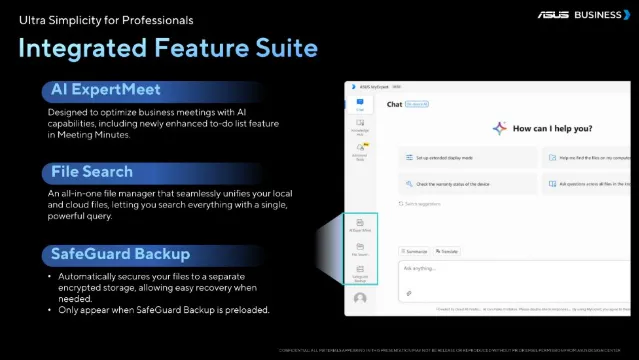
Alongside these controls, enterprises will need to establish whether AI laptops deliver meaningful improvements to work.
“We believe the real value of AI PCs should be measured by business outcomes rather than individual AI features,” Rex said.
He identified time saved, adoption, satisfaction and operational efficiency as relevant measures.
The purchasing decision therefore extends beyond device specifications. Enterprises need to assess where AI can improve employees’ work and, as assistants gain the ability to act across business systems, define the limits of that authority. The business case for AI laptops will depend on whether they help employees complete tasks more efficiently. As agents take on more of those tasks, enterprises will also need guardrails to keep their actions within the scope of the work assigned to them.