By Charles F Moreira
Juniper Networks has made a good start in 2013 in technology announcements, with the most exciting being its software defined networking (SDN) solutions, said Abdul Aziz Ali, its country manager of Malaysia & Brunei.
The others are its highly compact and energy efficient PTX 3000 Packet Transport Router with Converged Supercore technology and the integrated packet transport 100G DWDM OTN (100 Gbit dense-wave division multiplexing optical transport network) interface card.
The problems
“A big telco refreshes its network every five to 10 years and the last time it did so was six years ago,” said Abdul Aziz.
Back then telco networks were built to handle corporate virtual private network (VPN) traffic and a 10Mbps network connection to desktop PCs was ample but today, 100Mbps and 1Gbps to the desktop are common.
Also, the explosion in use and number of Internet-enabled devices such as PCs, tablets and smartphones, coupled with more downloads of bulky content such as pictures and videos, IPTV Web-based cloud applications and the growth of cloud computing have all resulted in an explosion of traffic carried over networks, while security threats are more serious due to the wider exposure.
“All these puts more burden on networks to grow to be able to cope, so telcos must look for a high-density platform, which is where Juniper can help provide a solution,” said Abdul Aziz. “Besides providing high-end routing to telcos, we also provide mostly switching and security solutions to enterprise customers, including government, financial services and manufacturing.”
 |
| Abdul Aziz Ali |
The government sector will deploy many more applications online and will continue to build its network infrastructure to cope. Banks’ front-desk operations such as call centres are increasingly IP (Internet Protocol) based, which imposes greater loads on networks.
Likewise in manufacturing, especially of electronic devices which need to download software to them as quickly as possible, while manufacturers also share bulky computer-aided design and engineering (CAD/CAE) files online, and collaboratively work on them across borders, so they need robust LAN, Intranet and Internet connectivity.
The solutions
Juniper obtained SDN technology through its acquisition of Contrail Systems for US$176 million in January. SDN effectively virtualises networking devices to make the network easier and cheaper to manager. By using interfaces such as the OpenFlow protocol, which are based upon open standards.
SDN supersedes much of the functions of firmware embedded in routers and switches made by Juniper as well as Cisco. Juniper’s SDN approach includes some OpenFlow capabilities plus its own Qfabric approach to reduce network layers. Juniper’s layered approach separates networking into forwarding, control, services and management layer.
Contrail developed its SDN solution for enterprise networks, though it can also be used in telecommunications networks.
“For example, a Juniper box which handles one million calls in a mobile network has to take into account many factors such as call routing, billing, customers plans, system messaging and so on, and when new services such as prepaid are introduced, its call handling capabilities are reduced due to the heavier load,” said Abdul Aziz.
“However, SDN takes over this load and performs its functions within the a common platform, which relieves the telco’s system of having to process routing tables, customer databases and others by offloading it to a private cloud operated by the telco.
“SDN can also be applied to in enterprise, bank and other organisations’ networks. Moving forward, the opportunities are limitless and Juniper wants to help our customers protect their investment in routing equipment,” Abdul Aziz added.
The PTX 3000 is the industry’s smallest-footprint supercore router which occupies 12.5 x 10.5 inches floor space and is 36.4 inches tall. It comes with 4Tbps capacity and scales up to 24Tbps. Juniper says it delivers up to six times more performance for space-constrained markets.
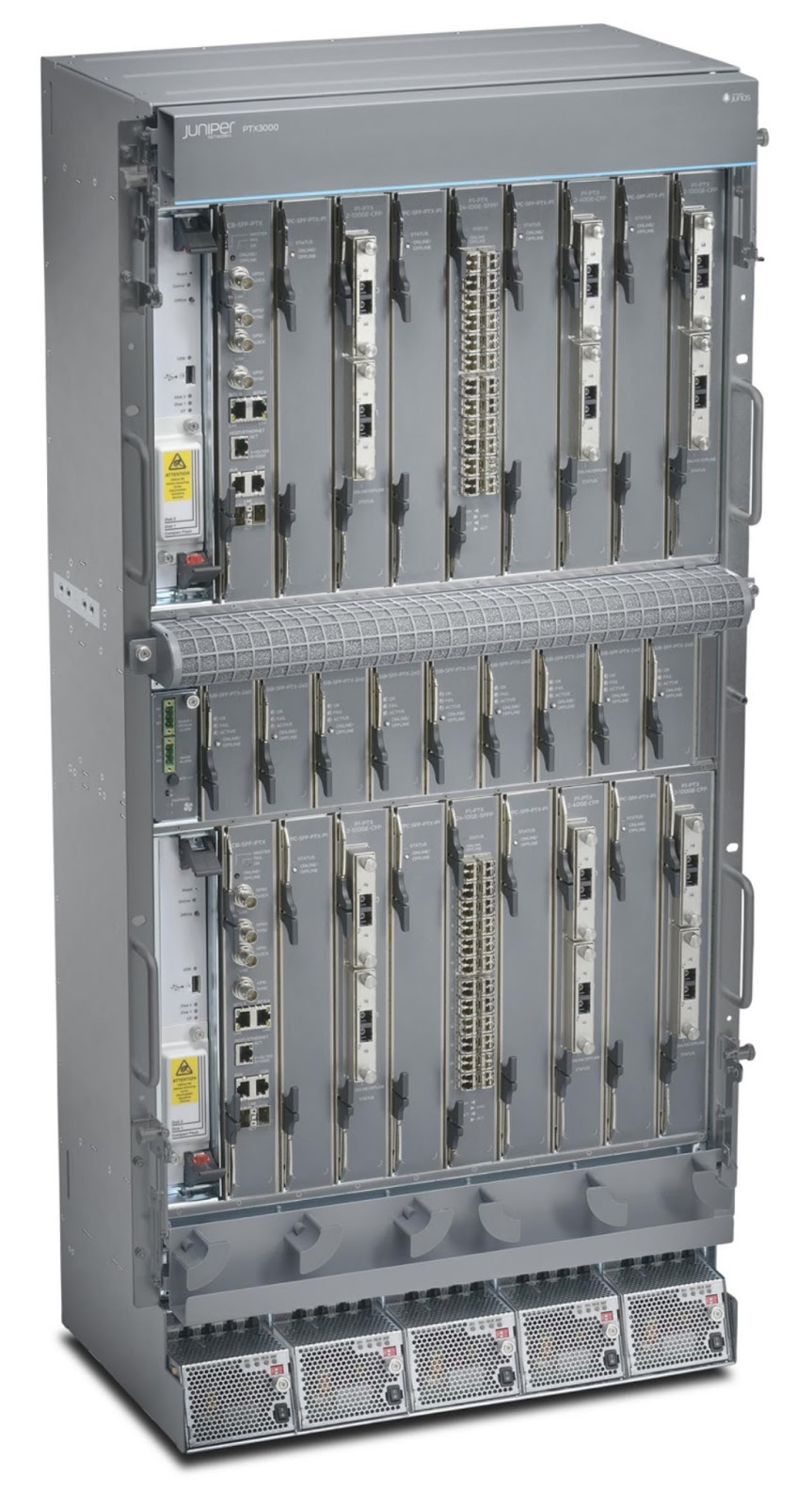 |
| PTX 3000 |
It’s energy efficiency is 1.2 Tbps per kilowatt, the industry’s lowest, has the industry’s lowest latency of 5 micro-seconds and emits about 10,000 BTU of heat when fully loaded. Juniper’s PTX series are optimised for MPLS (Multi-Protocol Label Switching) and Ethernet protocols, with coherent 100 Gbit Ethernet technology.
Meanwhile the 100G DWDM OTN interface card efficiently connects metropolitan area network (MAN) sites at distances of up to 2,000 km apart.
It offers the industry’s highest density 100G optical routing capabilities for use in open, standard-based architectures, effectively reduces network complexity, offers transport performance with packet advantages, while it operates across the entire PTX Series.
With these products and solutions, Abdul Aziz hopes to build upon Juniper’s strong growth in Malaysia last year, thanks to his predecessor Wan Kamal who was promoted to manger for ASEAN.
Last year, Juniper announced a new upgrade to its TXP multi-chassis routing system for its T4000 and T1600 core routers, its MX Series 3D Universal EDGE Routers – a family of Ethernet routers for very large scale, as well as medium—to-small scale applications in enterprise routing and telco networks. Also launched was its ACX Series Universal Access Routers and its security solutions.
In November 2012, Telekom Research & Development (TMR&D) signed a memorandum of understanding (MoU) with Juniper on closer research collaboration.
Under the MoU, the two companies set out key principles to pursue joint marketing activities and exploration of market research and development projects. Led by a joint steering committee, both companies would explore the establishment of technology test beds and determine ways to efficiently deliver training for TMR&D customers.