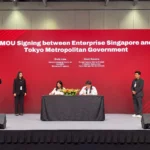

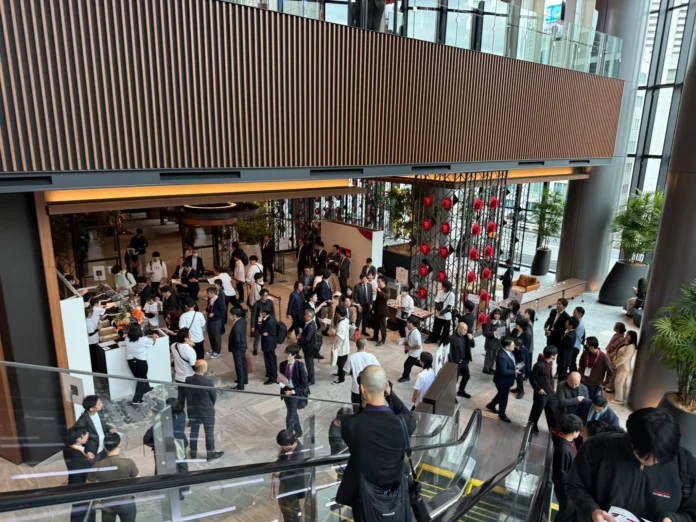
Red Hat Summit: Connect Tokyo 2026 opened with a keynote from the president of Red Hat Japan, Miho Miura talking about three competing demands that enterprises today face, and how the central challenge is being able to address all three without more cost and risk.
She was joined by a line up of keynote speakers, notably Takeshi Izaki, Vice President, Enterprise Business, NVIDIA Japan, who presented about the AI Factory and how it is essentially a unified technology foundation for moving enterprise AI into production at scale. “I believe this product came about to meet that exact need,” said Takeshi-san.
NVIDIA would frame the AI factory as an industrial production facility designed to manufacture digital intelligence in the form of tokens – vertically integrated and full stack accelerated infrastructure (GPU, networking, software) process inputs in the form of raw data and electricity to output digital intelligence measured in units called tokens.
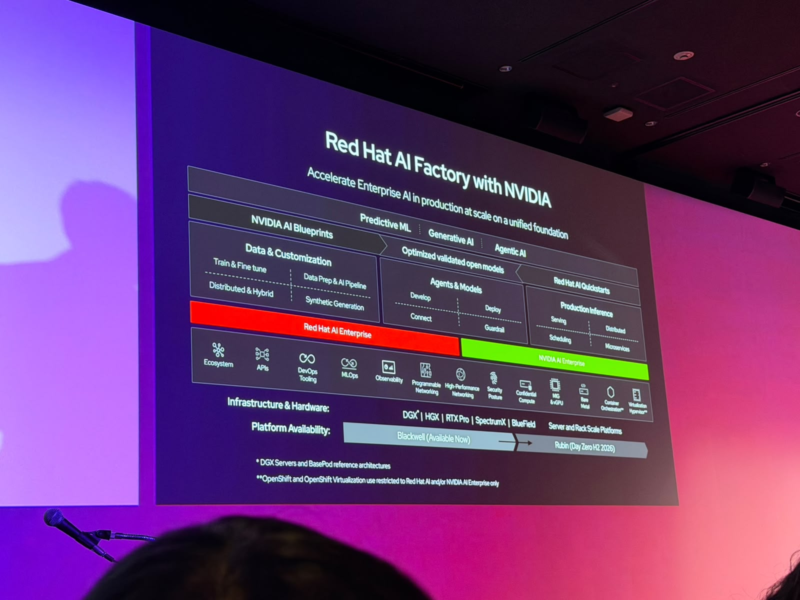
With more enterprise AI workloads moving to production, inference is becoming the dominant workload.
The Red Hat AI Factory with NVIDIA spans predictive machine learning, generative AI and agentic AI, and brings together Red Hat AI Enterprise and NVIDIA AI Enterprise. Its architecture groups into three main areas: data and customisation, agents and models, and production inference.
Underneath are shared capabilities such as APIs, developer tooling, MLOps, observability, networking and security, followed by infrastructure and hardware. In summary, this is the platform stack to support AI beyond an isolated proof of concept.
AI-speed attacks – the open source response
Red Hat also zoomed into how advanced AI has become and the threat it potentially poses to organisations. The industry has shared a forecast that there can be as many as 66,000 CVE disclosures in a year. This is a pace that existing manual vulnerability triage and patching will find difficulty keeping up with human engineering teams alone.
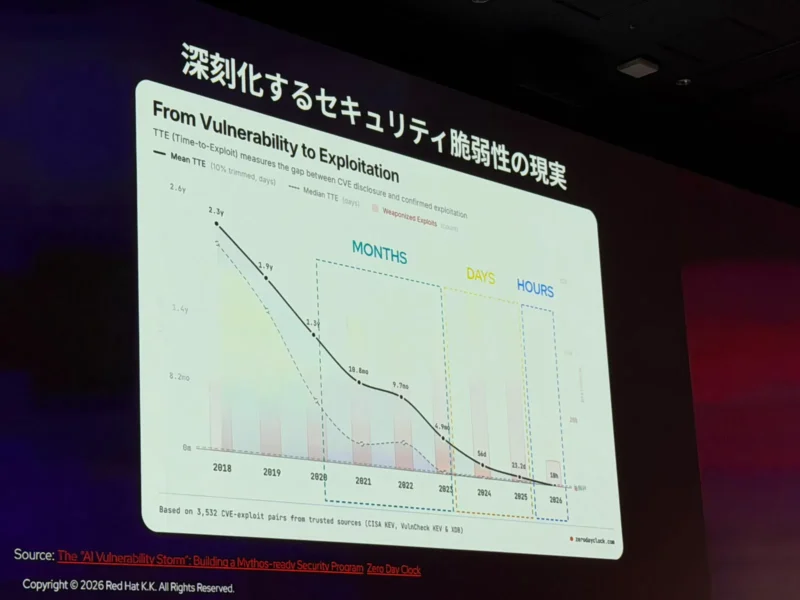
At the sidelines of the conference, Acumen Intelligence’s tech and AI lead, Aaqib Alavy said, “Attackers can exploit newly disclosed vulnerabilities: a recent PHP flaw was reportedly targeted within about 18 hours, while deploying patches can take 10 to 40 days. That widening gap puts pressure on organisations to improve early detection, maintain continuous visibility, and respond faster.”
The keynote had highlighted that the window between vulnerability disclosure and weaponised exploitation has collapsed from years to hours; in 2018 the mean Time-to-Exploit (TTE) of a CVE was about 2.3 years but this has collapsed to 18 hours in 2026.
That widening gap puts pressure on organisations to improve early detection, maintain continuous visibility, and respond faster.
Aaqib Alavy
This creates an urgent operational requirement for proactive, automated remediation rather than reactive manual patching.
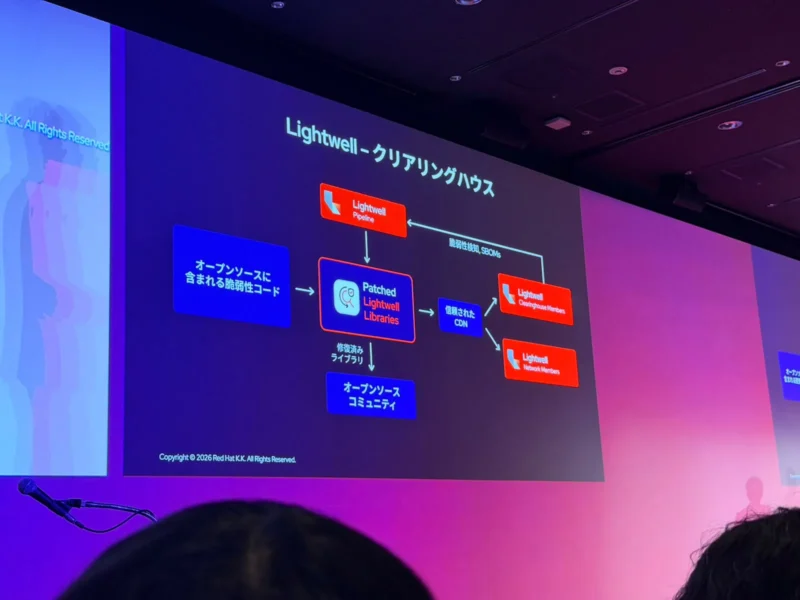
Red Hat’s response to this is Lightwell, an AI-driven supply chain security clearing house it founded together with IBM to automatically identify, patch, and distribute fixes for open source vulnerabilities before attackers can exploit them.
With modern enterprise applications relying on thousands of independent third-party open source libraries, this critical 5-billion dollar initiative was designed to secure the open source software supply chain across the entire application lifecycle.
Notably, Lightwell is able to provide continuous open source patches; an AI agent would even detect where patches must be applied and even determines where in the software development lifecycle (SDLC) a patch is required.
On top of that, Lightwell is embedded into Red Hat OpenShift continuous integration (CI) which provides capability to automate vulnerability remediation directly inside the software build and delivery pipeline.
Secured boundary
Aaqib sees projects like Lightwell and also NVIDIA OpenShell as being potentially helpful with early detection of threats.
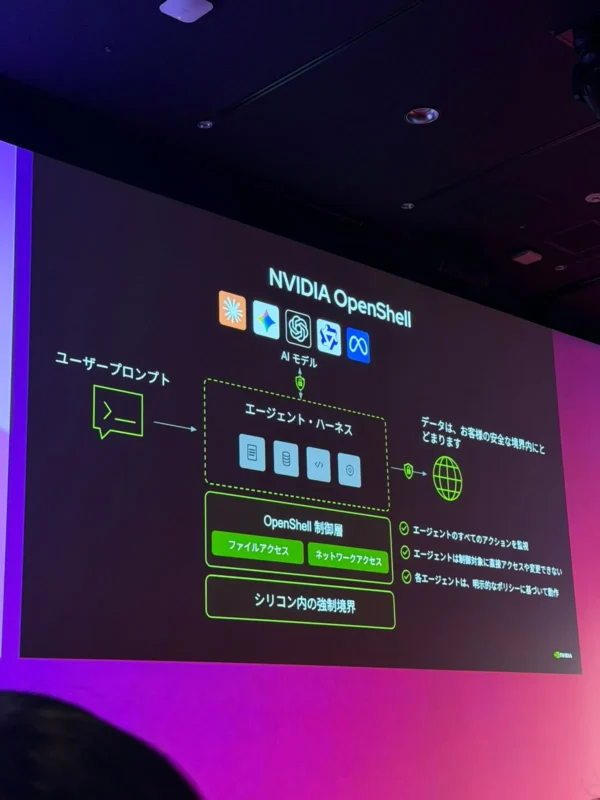
NVIDIA OpenShell is an open source, policy-governed runtime designed to sandbox autonomous AI agents and restrict their execution environment.
Autonomous agents differ from chatbots because they interact with tools, call external APIs, generate code, and query file systems, among other things. OpenShell treats these agentic workloads as untrusted and wraps them in sandboxes which are like isolated environments.
Aaqib described OpenShell as providing “a sandbox to view and reject any illegal usage by controlling port access and file read/write permissions.”
Organisations need to be able to scale autonomous AI operations without compromising security, governance, or business continuity. Upstream-first protection initiatives like Lightwell and OpenShell, are critical foundations for AI adoption that accelerates business innovation – or merely expands the attack surface.