
People need to feel safe enough to use digital services.
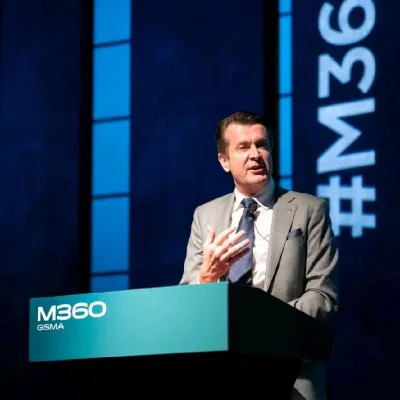
That is a growing focus for GSMA in Asia Pacific, according to Julian Gorman, its regional head. The priority, he said, is to turn connectivity into “meaningful digital participation” – with reliable networks, useful services and safeguards against scams and fraud.
GSMA estimates that the mobile economy in Asia Pacific, excluding China, contributed about USD1 trillion last year, or 5.9-percent of GDP. Gorman said the association expects that contribution to reach USD1.4 trillion by the end of the decade, as 5G, AI and digital services spread across industries.
But widespread coverage has not led to universal use. Julian said more than 98-percent of the region’s population is covered by mobile broadband, while hundreds of millions of people remain offline or do not use the networks available to them. “Seven hundred million people are still offline.”
The reasons extend beyond the cost of a device or data plan. Some people lack relevant digital skills or services; others are wary of going online. Scams can deepen that hesitation. Julian cited survey findings that around 8-percent of people in Southeast Asia and one in eight in India had been scammed in the previous year.
“Digital trust is much broader than” protection from scams, he said. It also depends on networks and services being secure, reliable and accountable. Yet scams are increasingly sophisticated, often relying on social engineering rather than breaking into networks. Julian said more than 90-percent of scams are estimated to involve social engineering.
Using network signals to spot risk
One response is to make mobile networks’ capabilities available to other industries through application programming interfaces, or APIs. GSMA’s Open Gateway programme has a portfolio of more than 60 APIs, Julian said, including tools intended to help organisations assess risk and authenticate users.
One example is silent number verification. Unlike a one-time password sent by SMS, it can authenticate a device through the network without asking the user to read and enter a code. “That could help reduce the risk of interception by bad actors, “ Julian said.
A SIM-swap API can provide another signal: how recently a SIM card was moved to a device. Julian cautioned, “That doesn’t prove anything particularly. But if the SIM’s only been in the phone for an hour or a couple of hours, that’s a different risk than if the SIM’s been in the phone for, say, two years, and people can use that in their assessment of risk.
Making such tools available is only part of the task.
Julian emphasised, “So we we have in Asia Pacific launched a cross sector programme called the GSMA APAC Cross-Sector Anti-Scam Taskforce (ACAST) that includes nearly 40 organisations from 70 countries, including mobile operators, Google, Meta, Amazon, so come together to help identify and prioritise actions that we can take together to help combat scam and fraud.”
He also described a Southeast Asian proof of concept exploring collaboration and data sharing between mobile operators. He said the pilot was “looking into the network to look for signatures of suspicious behaviour” and could “provide risk signals before the scam happens”
This exploratory effort would involve working with the likes of Tencent, TikTok, Meta, and Mastercard.
Digital forward
Julian said telcos need to build on connectivity rather than move away from it.
“Advanced connectivity is becoming the platform for the next phase of economic growth,” he said, describing the network as “an intelligent pipe” that combines connectivity with cloud, edge and AI capabilities.
He also thinks that operators can become trusted infrastructure providers for AI, enterprise and public services, and digital commerce.
For him, the opportunity goes beyond adding subscribers. “It’s about improving enterprise productivity efficiencies, automation, and reducing fraud.” Network APIs and initiatives like the Open Gateway project, he added, can expose network capabilities to the wider ecosystem to “drive innovation” and help transform industries.