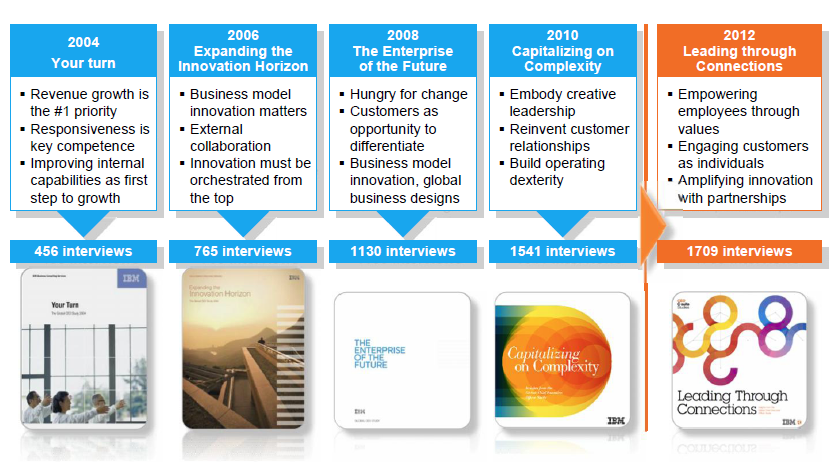
A new IBM study of more than 1,700 Chief Executive Officers from 64 countries and 18 industries reveals that CEOs are changing the nature of work by adding a powerful dose of openness, transparency and employee empowerment to the command-and-control ethos that has characterised the modern corporation for more than a century.
The Global CEO Study 2012 is the fifth biennial CEO study, building insights and findings over the last 8 years. It represents organisations in 64 countries across 18 industries.
Generally, CEOs in ASEAN countries identified the followings as the most important external forces that will impact their businesses.
- People skills
- Market factors
- Technology factors
Internally, CEOs feel that human capital is the no.1 factor in sustaining a business for continuous growth, while customer relationships comes in second and product innovations settles for third place.
Therefore, it is essential that CEOs create more economic value of their businesses by focusing on the following three domains of activities.
1.) Empowering employees through values
2.) Engaging customers as individuals
3.) Amplifying innovation with partnerships
Empowering employees through values
To achieve this objective, the followings can be performed.
1.) Cater for more collaboration via means of technology.
Employees must adopt the following key success factors.
- Collaborative
- Communicative
- Creative
- Flexible
2.) Create an open culture. Open culture can measured using the following indicators.
- Partnering/collaborating with other organisations
- Internal collaboration
- Decision-making processes
- Skills and responsibilities
- Organisation structure
- Governance models
- Values of the organisation
- Supervisory board composition
Engaging Customers as individuals
To achieve this objective, the followings can be performed.
1.) Value, listen-to and analyse customers as individual basis.
Customers can help to provide many insights which are valueble for organisation to move forward. These insights consist of:
- Customer information
- Operations efficiency
- Sales effectiveness
- Markets and competitors
- Human resources efficiency
- Supply chain efficiency
- Risk management efficiency
- Financial efficiency
2.) Capitalise social media
CEOs may want to understand individual customers better and respond faster. Besides that, it is also important to harmonise customer experiences across channels, increase transparency and corporate accountability and increase social and environmental responsibility.
3.) Big data, social media and mobility
At this stage, it is important to understand that big data is useful for organisations to look outside in order to enable thinking-out-of-the-box. Social media and mobility allow collection and analysis of data up to individual level and also cater for high availability of product services.
Amplifying innovation with partnerships
To achieve this objective, the followings can be performed.
1.) Partnering with others through product integration to speed up customer adoption as well as identify effective avenues for innovation; by not reinventing the wheel.
2.) Sales and marketing channel partnering for better outreach and customer information.
“CEOs realise at this point that even greater levels of control are not the key to greater innovation and financial performance. Rather, leaders have seen how extremely dynamic social networks can serve as the foundation of amazing levels of collaboration. ASEAN CEOs, in particular, are keen to leverage social networks and focus on collaboration – both internally and externally with customers and partners,” said Anthony Marshall, Global CEO Study Program Director, Institute for Business Value, IBM.
 |
 |
| Anthony Marshall, Global CEO Study Program Director, Institute for Business Value, IBM | Mohd Arif Ibrahim, General Manager, Global Business Services, IBM Malaysia |
“Given their intent to create greater openness, CEOs are looking for employees who will thrive in this kind of atmosphere. CEOs are increasingly focused on finding employees with the ability to constantly reinvent themselves. These employees are comfortable with change; they learn as they go, often from others’ experiences,” said Mohd Arif Ibrahim, General Manager, Global Business Services, IBM Malaysia.