By Brandon Teoh
Powerbloc Generation (M) Sdn Bhd. (“Powerbloc”) was setup in 2004 by two founders En. Mokhlis Abdul Karim and Mr. Goh Chin Tiong, both are Malaysian computer scientists. They had a very simple vision; that is to provide every PC in the world with security solutions.
Staying true to this vision, Powerbloc is today considered to be one of Malaysia’s growing IT security solutions and services providers. They provide quality assured end-to-end integrated IT security solutions and services to enterprises in the private and government sectors.
Powerbloc has been F-Secure’s Sole Distributor for South East Asia region since 2004. Its clientele from public sector includes the likes of Tenaga Nasional Berhad, Petronas Carigali Sdn Bhd, Lembaga Tabung Haji, Jabatan Pendaftaran Negara, Kementerian Dalam Negeri and etc.
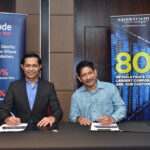
On Nov 2, 2012, Powerbloc signed a MOU with US-based nexTier Networks (“nexTier”) to become its authorized distributor for its Data Leak Prevention (DLP) solution for Brunei, Malaysia, Indonesia and Singapore.

DLP is a technology which helps to control illegal possession of confidential data.
In the industry, there are two types of DLPs namely traditional DLP also known as accidental DLP or malicious DLP also known as intentional DLP. One good example of accidental DLP is the accidental inclusion of unintended recipient in an email list.
nexTier’s CEO Mr. Tarique Mustafa said that its DLP solution is the industry first and only DLP solution for malicious data leak prevention. Most other solutions out there claimed to be able to solve malicious data leak prevention are actually over-sell. In actual fact, most of these solutions from competitors can only deal with accidental data leak prevention.
Truth to the matter is that 61% of data thefts are intended or malicious and have gone undetected.
Research conducted by Accenture 2011 – Mind the Gap – Insights from Accenture’s third global IT performance research found that high performers take security strategy and data protection protocols seriously – 226 of the world’s largest private and public-sector organizations have been analyst by the Accenture High Performance IT team.
The market drivers for this trend are:
- Regulatory compliance
- Intellectual property
- Personally Identifiable Information
- High value information & sensitive data protection
- Financial costs
- Negative public exposure & brand damage
- Worldwide business collaboration & international offshore businesses
- Sense of responsibility
nexTier DLP solution and technology works by monitoring data located across the enterprise and determining that data’s security value to the business. In essence, it is based on heuristic and semantic technology which is similar to tech powering antivirus technology.
nexTier’s patented semantic analysis algorithms can auto-classify data/information, correlate that information to the identity & roles of actors in the enterprise and use that 3-dimensional correlation as a means of enforcing securities policies against that data. Resistant to evasion, the algorithm can determine the origin of information even if it has been retyped into a brand new document or rearranged and reworded in an evasive manner.
Mr. Tarique called this a paradigm shift for data leak prevention technology where it addresses solutions in a much holistic manner. The technology is currently considered to be 4th generation DLP which it has the capability to support unstructured semantic analysis. This allows the solution to automatically identify and classify data/content regardless of its modality; be it either structured or unstructured.
This Automated Data Identification and Data Classification capabilities result in the elimination of ‘Manual Classification and Tagging’ process hence enabling a more sophisticated and less error prone DLP paradigm. As a result, lower TCO becomes more achievable.
Automated Policy Synthesis is another key characteristic of 4th generation DLP products.
The product offering for nexTier’s 4th generation DLP is the Compliance Enforcer (CE) DLP which is a network based solution enforcing security controls at network endpoints. It is pre-configured as a rack-mountable appliance. It is also known as the semantic firewall.
Traditional DLP solutions are usually based on access rather than content. As a result, these products do not have the ability to perform the following which are crucial for performing malicious-based DLP:
- Perform Automated Security based on Data Classification
- Perform Automated Data Discovery
- Perform Automated Security Policy Synthesis
In order to have a better perspective, here are the nutshells of 1st generation, 2nd generation and 3rd generation DLPs, all of which lack capability of performing effective malicious DLP.
1st Generation DLP – These solutions started off as Digital Rights Management (DRM) solutions that were closely integrated with document creation and authoring tools. For example, Adobe Live Cycle from Adobe Systems, Authentica (acquired by EMC) and Liquid Machines (acquired by Checkpoint). The key idea was to set up controls on the document itself so that only authorised users of the document can perform read/write and other operations on the document. A basic example is credentials based controls (e.g ‘password protection’) for the documents so that only authorised individuals who had knowledge of the ‘Password’ could open, edit or copy/paste the document’s content.
2nd Generation DLP – These DLP solutions were focused on identifying and protecting ‘Structured Data’ such as credit card information or social security number. These solutions were built using basic ‘signature matching’ technology such as regular expressions and pattern matching algorithms. These solutions had limited applicability, as they were only capable of identifying (and hence protection) the Structured Data that can be mapped using the Signature Matching technology.
3rd Generation DLP – These solutions were focused on identifying and protecting “Unstructured Data” such as loosely formatted documents, text, pdf or word files, emails, power point presentations, memos, spreadsheets, etc. These solutions were invariably built using one form or another of “Document Fingerprinting” algorithms. Unfortunately, these solutions could not scale in their effectiveness and usability beyond the simple and trivial use case scenarios in real-life enterprise deployments.
These 3rd generation solutions are severely marred by their dependency on Manual Classification and Tagging of content. This dependency on manual pre-processing renders these solutions to be cumbersome and error-prone in real-life deployments. Furthermore, the total cost of ownership (TCO) over the life cycle of these products is very high due to the cost associated with Manual Classification and Tagging. Hence, these DLP solutions have been “very maginaly” successful due to their inability to correctly Identify, Classify and Protect the confidential data in automated fashion.
Examples of “Malicious Data Leak” techniques that only 4th generation DLP can address are :
- Manipulating structural, lexical or temporal composition of the content (e.g. emails, spreadsheets, ad-hoc documents, etc.)
- Utilising known “Vulnerability” of Data/Content Identification and/or Matching Algorithms
General Manager of Powerbloc, Sri Utami Dewi Hj Kasman said, “No other security provider provides such a contextually-aware and complete suite of DLP solution in the industry today that comes with built-in semantic analysis and automated security policy management. The partnership with nexTier will allow us to offer the benefits of this technology to the Malaysian market, to help organisations reduce the risk of negligent or malicious disclosure of confidential and sensitive data”.
She added that financial institutions and the public sector will be Powerbloc’s key target markets for nexTier’s DLP solution in Malaysia. The company has appointed Night Electronics (M) Sdn Bhd and MSP Systems (M) Sdn Bhd as two of the channel partners to resell the solution. Powerbloc capabilities provide value-add to product offerings and this includes:
- Technical support and maintenance = 24 x 7 on-site and off-site
- Technical training for customers
- Certified and experienced engineers manpower
- Assured quality in terms of service excellence
Powerbloc is also Value Added Distributor for iPrism (Secure Content Management solutions) and Accellion (enterprise-class secure file sharing solutions).
This is the most exciting time for Powerbloc to be appointed as the authorized distributor of its Data Leak Prevention (DLP) solution for Brunei, Malaysia, Indonesia and Singapore.
It was just not more than 3 weeks ago that on Oct 23 2012, Information, Communications and Culture Minister Datuk Seri Rais Yatim has confirmed that the Personal Data Department has been setup up finally and the Personal Data Protection Act (PDPA) will be enforced by Jan 2013.
It enforces that ‘personal data’ manipulation is subjected to legal consequences when it comes to commercial activities, only. This includes misuse and mishandling of information by enterprises which can come under the category of malicious data leak – nexTier DLP solution is just in time for Malaysian enterprises to deal with PDAP enforcement.
nexTier’s Compliance Enforcer (CE) DLP supports text, image and video data analysis. To get started is easy, all users have to do is to perform role-based (duty of employees) segmentation for data classification using software available.
It also works with encrypted data where known encrypted technology (SSL, VPN and etc) has to be declared in the settings in other to authorise sniffing of such data.
According to Tarique Mustafa, it is easier to understand the whole picture by thinking of Wikileaks, the threats which it can bring upon enterprises and organisations, and the costs that come with it.