
By Charles F. Moreira
While the industry often highlights the power, sophistication and benefits of emerging computing technologies such as virtualisation, big data, cloud computing, business analytics and other IT aspects, rarely mentioned are the resiliency, reliability and availability of the underlying physical infrastructure upon which they all depend, said Martin V. McCarthy, chairman and chief executive officer of 451 Research, a division of the 451 Group.
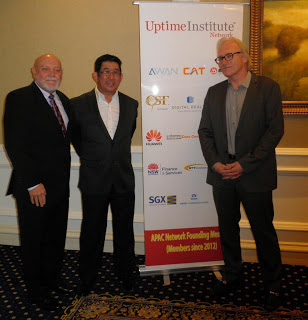 |
| Pitt, Yong and McCarthy |
“If a large enterprise system, such as a bank’s goes down just for one second, it could take as much as eight hours to restore it and if there are 100 branches, that adds up to 800 man-hours,” said Adrian Yong, president and group chief executive officer of the CSF Group of Companies.
CSF operates three wholesale data centres in Cyberjaya plus one each in Johor Baru, Hanoi and Indonesia. It’s also a founding member of the Uptime Institute’s Asia-Pacific Network.
The New York-based 451 Research is a syndicated research, advisory and professional services firm which provides critical and timely insight in emerging enterprise IT technologies, especially in areas of cloud computing, data centre technologies, eco-efficient IT, enterprise security, internet infrastructure services, infrastructure computing for enterprise, information management and multi-tenant data centres.
The 451 Group established the Uptime Institute in 1993 is an independent membership organisation of users which provides education, publications, consulting, certifications, conferences and seminars, independent research, and thought leadership for the enterprise data centre industry and for data centre professionals.
Downtime
The physical infrastructure includes critical constituents such as electrical power supply, mechanical and cooling systems of IT equipment, without which the cloud would not exist.
For example, the recent Hurricane Sandy which hit New York and New Jersey flooded the basement of a building housing a data centre and prevented its backup generators located there from working, while the main electricity supply also went down, so the data centre went down too.
Altogether, nine data centres in the area went down due to failure of their key infrastructure, including the inability to replenish their fuel supply in time, given the unusual circumstances in the wake of that major disaster.
“These data centre operators took it for granted that such catastrophes happen elsewhere but not in the U.S. for 70 years, so they did not move their servers to a safe location and once disaster strikes people will become more careful,” said McCarthy.
“These failures were due to the legacy nature of these sites but while one of the nine, a consumer database went down for six to nine minutes, consumers did not notice because the network was able to route traffic to backup or mirror sites, and this is a unique indication of the power of cloud,” said W. Pitt Turner, executive director emeritus of the Uptime Institute.
“The other issue is that not everyone can re-route their traffic to alternative sites, since such facilities and connectivity are expensive and the importance of the site to the owner did not justify the additional cost,” said McCarthy.
However, while nine went down, hundreds remained up, including the NYSE Euronext site which remained up on generator power.
Power
On whether using low power PCs, servers or mainframes are as effective as claimed, McCarthy said that progress has definitely been made in this area in terms of low-power chips but also depends on the use of more energy-efficient software.
“However, more significant is the overall power consumption of the whole data centre, which has to be lowered, and we believe that especially in Asia, the third-party data centre can player a bigger role which gives enterprises the option to choose which of their computing functions to perform in-house and what to entrust to third parties,” said McCarthy
“As an analogy, while a car may have much lower fuel consumption compared to a bus but in terms of energy efficiency per passenger carried, a bus is more efficient,” Yong.
“Purpose-built data centres such as ours have the economies of scale, so can incorporate all the safety, reliability, security, connectivity, availability and other other such features which our customers may not be able to afford by themselves.
“All our data centres are outside of inner city areas, so are more readily accessible,” Yong added.
A typical high availability data centre will have at least two power lines, each coming from different independent sources, preferably from different utility companies, as well as two fibre lines, each from a different operators, perhaps plus a satellite link. It will also have backup generators with sufficient fuel and ease to replenish.
For example, CSF’s new Computer Exchange 5 (CX5) data centre in Cyberjaya stores 498,000 litres of diesel fuel which will keep it running for 36 hours at full load, plus a guaranteed replenishment rate of 10,000 litres within four hours. It’s an Uptime Institute Tier 3 certified data centre.
Launch on 9 January, 2012, It offers 201,000 sq ft of net data centre floor space and a gross floor area of approximately 580,000 sq ft. It had received provisional Green Building Index (GBI) Certified Rating which recognises the facility as a green, sustainable building, including its ability to provide energy savings, water savings, a healthier indoor environment, better connectivity to public transport, the adoption of recycling and greenery for their projects, and reduced impact on the environment.
It is Telecommunication Industry Association TIA-9421 compliant and has fully redundant subsystems including cooling, power, network links, storage and stringent physical security features.
Two on-site utility power stations are already constructed and mirrored duplication of mechanical & electrical plant rooms are ready on each data centre floor for future upgrade works. Its CX1, CX2 and CX5 data centres are connected to a dual-ring electrical grid with advanced fibre connectivity.
One of the best?

While Malaysia has one power utility, Cyberjaya and Putrajaya are served by two independent 33kv power rings and their recent SAIDI (System Average Interruption Duration Index) are among the lowest in the world, with Putrajaya having a rating of 1.25 minutes per customer per year based upon public sources, ahead of Singapore (2.2), Cyberjaya (3.92) and Japan (6.0).
This is way ahead even of the U.K. at 70 minutes per customer per year, the U.S. (214), while Colombia was really bad at 9,480 minutes per customer per year.
However, it isn’t apples for apples to compare two fairly small, new, lightly populated municipalities with whole countries. According to Tenaga Nasional’s 2012 annual report, its SAIDI was 63.32 minutes per customer per year in Peninsular Malaysia, slightly better than the U.K., while its subsidiary, Sabah Electric reported a SAIDI of 362 minutes per customer per year as at April 2012.
Tier4
Several data centres in Malaysia which we’ve spoken to claim that they cannot get Tier 4 certification because there only is one power utility.
“Let me clear up that misconception,” said Turner. “The Uptime Institute understands that many countries like Malaysia have only one power utility, so we don’t refuse them certification for that reason. Our certification criteria are based on a data centre’s deign, facilities and operations, and for us it isn’t how many different power utilities serve a data centre but the quality of its independent back up power generation, its hours of fuel-reserve and time to replenish,” he added.
“I would put it another way,” said McCarthy. “There are no Uptime Institute certified data centres in Malaysia and that is most probably due to cost, since for a data centre to qualify for Tier 4 certification is very expensive, which cannot always be justified against business requirements, so operators shouldn’t adopt technology for technology’s sake,” he added.
A high-volume trading house might need a Tier 4 data centre with mirror, data replication, the ability to move virtual servers between sites quickly and so on but less critical applications don’t. Also if a Tier 4 data centre hosts applications which aren’t fault-tolerant, there’s no benefit.
Businesses need to evaluate their investment cost in a data centre versus the business impact of its failure, including loss of business and regulatory penalties, if any.
Third world mentality
“Sure, you can build a great data centre but if you don’t maintain it well, it will eventually go down hill. You must be able to maintain the standard of the data centre over a long time, which is an added cost, and Malaysians are noted for not maintaining facilities well,” said Yong.
Uptime Institute certification typically costs tens of thousands of U.S. dollars which is small compared to the cost of the data centre.
Despite government efforts to make Malaysia a data centre hub in the region, several MSC Malaysia companies have reportedly said that they prefer to host in Singapore for its lower prices and far better quality of service. Now why is that?
“Malaysia’s Internet connectivity is generally slower that Singapore’s, especially the international links which usually go via Singapore and 30% of CSF’s customers are outside Malaysia,” said Yong.
Inadequate capacity of the wide-area network can also defeat the benefits of mirror sites and replication due to network congestion, especially during an emergency.
Looking ahead

According to Strategic Analytics, the growth rate in data centre revenue has been slowing in traditional market leaders such as Singapore and Hong Kong due to high wages and rising real estate costs, and also in Vietnam with a high growth rate of about 35% this year is expected to slow to about 28% in 2014.
Growth in Indonesia is pretty rapid, speeding up from around 10% in 2010 to about 14% in 2014, while the rate in Malaysia has been accelerating gradually from around 16% in 2012 to 17% in 2014. Overall growth across the region is still positive at about 20% annually.
The next 12 months will see greater importance being placed on the business value of data centres and digital infrastructure and there will more likely be greater investment in mirroring, data preparedness and disaster response.
McCarthy, Turner and his colleagues were in Kuala Lumpur on 27 and 28 November to welcome 18 founding members into the Uptime Institute’s Asia-Pacific Network and for its 2012 Asia-Pacific conference, hosted by the CSF Group,.
Besides CSF, the rest of the 18 are CAT Telecom and PTT ICT Solutions of Thailand, China Merchants Bank, Digital Reality Data Centre Solutions, Elitery, Huawei, Keppel Data Centres, Morgan Stanley, NSW Government Finance & Services, NTT Communications, Singapore Exchange, Tata Communications, TCC Technology and others.