
By Cat Yong
Hitachi Data Systems or HDS boasts its highest revenue in history with market leadership in storage virtualisation for 2012. If CTO Hu Yoshida’s top ten predictions are any indication, the storage vendor is also well-poised to take advantage of storage usage trends which are slated to take off in 2013.
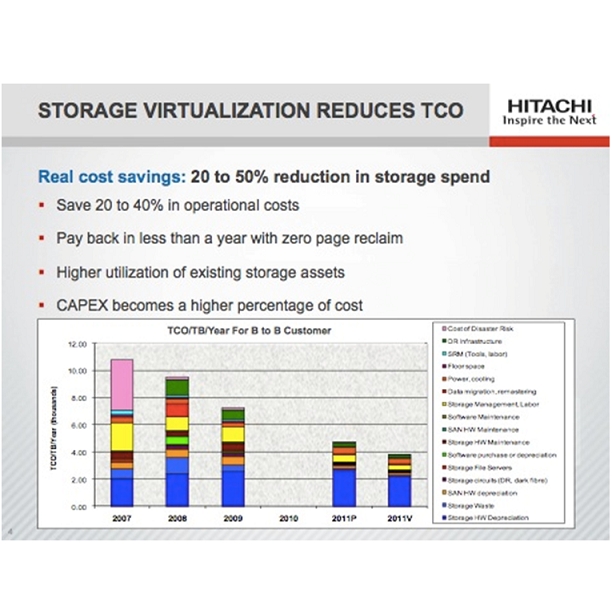
For example, one of the highlight trends by Hu has to do with organisations’ financial model, and how a combination of factors, might see the rise of the consumption model, that emphasises more operating expenditure instead of capital expenditure.
The consumption model
Analyst company Gartner echoes that 25% of infrastructure purchase would be based on per-unit charge. In other words, businesses are getting behind the notion of only paying for what they use, and rather than paying capital costs, they are translating that to operational costs.
 |
| Hu Yoshida |
“The consumption model largely refers to the cloud. But it can also be be through leasing and managed services,” explained Hu who was recently in Singapore to present his 2013 top ten predictions to journalists in the region.
How this works is that storage is already provisioned, but only storage that is used, would be paid for. “Customers don’t have to pay a license charge, they don’t have to pay a maintenance charge. It’s just one cost for incrementally provisioned storage.”
HDS also already has offerings to cater to customers who want to transform their cost expenditures and Hu described, “So storage can be located in the cloud or on their premises through leasing or a managed service. And it can be behind their firewall. So sensitive data can still reside behind their firewall.”
ASEAN take up
Ravi Rajendran, VP and general manager of HDS in ASEAN said, “The consumption model is relatively new in terms of maturity. If you look at some of the key enterprise (verticals), we are starting to see they are looking at implementing a private cloud, based on virtualisation. “
He added that these clouds are typically private and on-premise, unless it involves certain applications which are not mission-critical and can be outsourced to a service provider. “But if you look at the SMB market space, I think there will be a larger uptake across most ASEAN countries. The SMB market in ASEAN is a very large market, and not every single one of them would be trying to implement their own IT solutions rather than to ride on a service provider who could do that for them, at maybe a lower cost or from a convenience standpoint.”
 |
| Ravi Rajendran |
The key industries however, like telcos, banking, insurance and so on, tend to pursue managed services. “These are the early adopters we see looking at managed services going forward, based on the consumption model.”
He also brought up cloud-based backup-as-a-service or archival-as-a-service, as one area they think customers will be looking out for so that they can continue to focus on their core competencies.
Storage vendor prerequisites
It goes without saying that the storage vendor that provides these type of services need to have the basic technology. For Hu, this would be the ability to do dynamic provisioning, non-disruptive migration, as well as also the ability to virtualise.
“So when you add an asset, they can still depreciate the asset without giving up the functionality, by that I mean virtualisation.
“Then, they also need to have the financial model, just to afford (providing this service).” This affording power, Hitachi Data Systems has in spades, considering that for its 2011 financial year, they achieved US$4.4 billion in sales, a staggering 15% increase from the previous financial year. Their software and services portion had also shown respectable growth, contributing about 50% of HDS total revenue and garnering US$ 1 billion in software revenue.
“Leasing or services… those are the things, a storage vendor would have to do to provide the consumption model. And it would be subscription-based and based on some sort of service level agreement,” added Hu.
Ravi also chipped in, “Technology is very important and underlining this. Virtualisation is also key otherwise we would not be able to achieve economies of scale. You’d also need scale-out architecture in the solutions that you have, because you would assume that the business would scale out over time.”
For Ravi, another key part also is service outfits that he feels vendors should provide to manage, to upgrade and to provision their customers’ environments. “We even have our own operations centre to provide services to customers that might need them, on the fly,” he said.
A business or financial model is also crucial because it determines how the vendor can help a service provider go out there with their service offering. So are relationships with strategic partners. “The key relationship that this storage vendor has with alliances is also important to bringing whole end-to-end services like VDI-as-a-service, to the cloud. On that note, we have formed strong alliances with the likes of VMware, Cisco, SAP, Microsoft and Citrix, to go out with offerings to the market.”
Hu also brought up the all-important matter of storage economics. “You need to have very good analytics. We have been doing what we call storage economics for some time now. So we have the tools and methodologies to figure out what our service levels should be and how much it would cost us. Because that way it will be fair to the customer and fair to us.”
“There is a lot of risk in storage technology when you keep over a number of years. Because technology changes, becomes obsolete, you need to be able to upgrade it… so as a storage vendor, we have a close view of what projections for technologies would be, and we have the economic tools to predict what those service levels should be and how much it should cost,” the CTO concluded.