The internal IT of an organisation has to adapt to the cloud, lest they start to become obsolete.
Michael Barnes, vice president and research director at Forrester opined, “The cloud augments internal IT, not replace it. But, If the IT department doesn’t adapt and improve how they provision services (and resources), they should disappear. The business it is supposed to support will source, consume and access (services) from another source like Infrastructure-as-a-service (IaaS) providers.”
However, he also shared that a survey done of 530 decision makers in Asia Pacific excluding Japan (APEJ) unveiled that Malaysia lags behind in cloud adoption. An experienced industry veteran even went so far as to venture that Malaysia lags behind by 2 to 3 years in terms of cloud technologies adopted. Whatever the reason may be, Barnes noted that the focus in Malaysia is data centre refresh, one of the early first steps towards data centre transformation, whereby virtualisation is being implemented. As many as 80-percent of organisations are at this stage: implementing basic virtualisation.
Another 15-percent are at the data centre renovation stage where functions like chargeback mechanisms, improved provisioning, automation and usage monitoring are being deployed. “Virtualisation here is well-managed and as many as 50-percent of servers could be virtualised,” said Barnes.
The final data centre transformation stage is popular among service providers who host and provision IT to other organisations and offer services like cloud bursting and so on. Barnes also pointed out a new way of cloud delivery; virtual private cloud; which arose because regulated industries like the financial and services industry (FSI) need more control over the data centre and its perceived security. “These organisations know where their data is and have insight and control over how their data is accessed.”
While the FSI industry would never consider public cloud to deliver Internet-based services to their customers, the virtual data centre is becoming increasingly attractive, especially for the purpose of disaster recovery and business continuity.
Another interesting observation that this Forrester analyst also had was how enterprise cloud is becoming increasingly personal, no thanks to consumerisation of IT and upcoming work trends like bring-your-own-device (BYOD). “The assumption that the enterprise cloud is something that is distinct and different from the personal cloud, is going away,” Barnes said.
For IT this means having to redefine control, and determining what parts can be controlled and what parts can be sourced from the cloud.
Barnes addressed members of the media about these trends during HP’s launch of their next set of cloud offerings, the HP Cloud System Quick Start Kit and HP CloudSystem Solutions.
HP’s part in all this
The all too real problem of IT departments being still burdened by legacy is necessitating HP’s upcoming set of cloud solutions. Brad Parks, HP’s Converged Infrastructure strategist called out the all too real reality that speed of delivery is critical, be it delivering a build-to-order PC, refreshing a data warehouse or updating the supply chain, doing tasks in weeks simply will not cut it anymore.
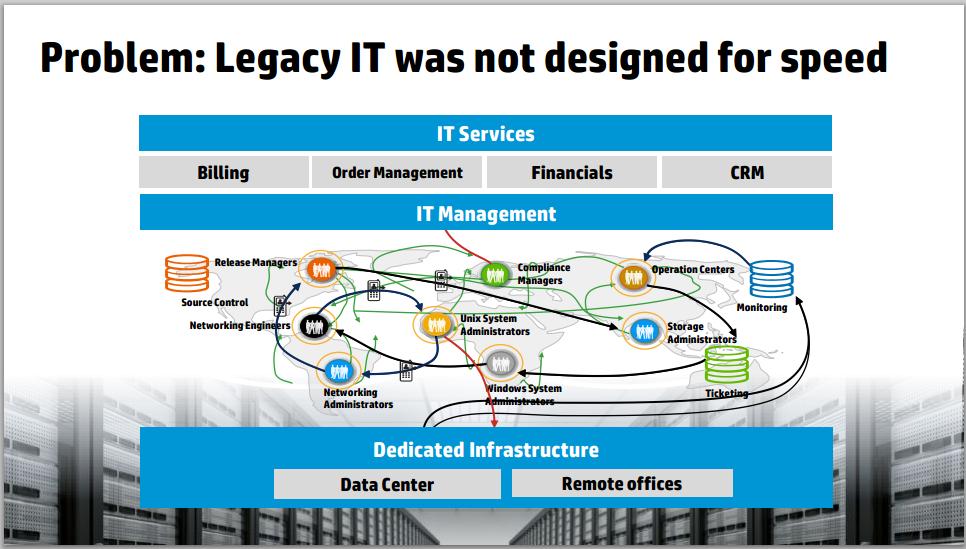
Same goes for implementing a cloud. If the top drivers for cloud adoption are rapid development of application, enhanced agility to respond to market changes and reduced costs of operations, it does not make sense that the technology to enable all this would take weeks.
The CloudSystem Quick Start Kit aims to provide a simple path to creating customised, pre-configured cloud infrastructure that meets specific business needs. Raymond Yap, country pre-sales manager for HP Malaysia’s Enterprise Group said, “There is appeal for this solution in Asia Pacific and Japan because there isn’t much legacy in this region.”
The new HP CloudSystem is basically a pre-configured bundle of HP’s blade servers, HP’s Virtual Connect FlexFabric as well as HP’s 3PAR F-Class storage arrays. And because faster application delivery is a priority, HP Cloud Maps, pre-configured and integrated software that are based on development, testing and relationships with independent software vendors (ISVs), clients and system integrators are also available.
With tools to rightsize the solution for organisations, up to 200 staff hours can be saved, per application deployed.