

By Cat Yong
Intel Security’s second annual tech forum in Kuala Lumpur saw over 100 participants from different functions and a diverse range of industries, in attendance.
Intel Security’s Southeast Asia MD, Craig Nielsen keynoted the event, calling to attention that the way malware attacks have evolved really calls for a change in security strategies.
This is also reflected in the way that Intel now has tighter integration with its Security group, and has come up with new solutions to enable this change in approach to security, for any organisation.
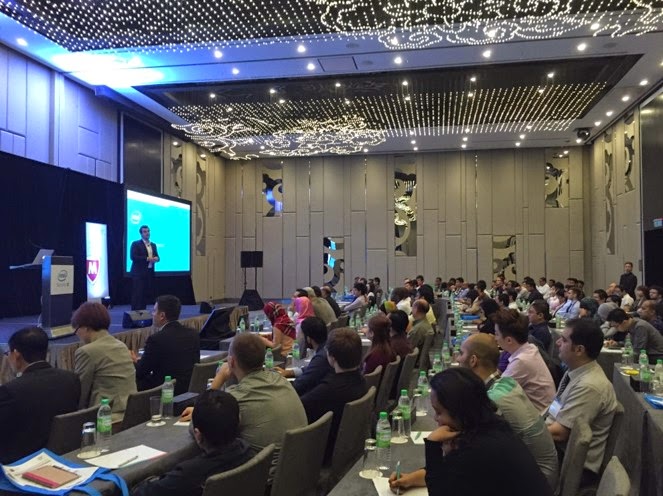
He observed, “The security challenge is all around Asia. But too many vendors are driving campaigns, just to get the purchase order (instead of working towards true outcomes).”
Intel Security however recommends businesses to redefine their security strategies, taking into account building for resilience and agility with a security connected approach, protecting complex, high-performance assets with visionary security features, and also looking to enable a next-generation architecture for integrated protection.
All these need to be done within a holistic risk framework.
The Intel Security Connected Tech Forum this year, also saw two Intel Security CTOs present to the audience, about real-life security situations, and not-yet-released Intel Security solutions that are going to debut in the next few years, if not later this year.
New trends, new vulnerabilities
With trends like cloud, mobility and the Internet of Things, attack vectors have increased tremendously. Every single device that every single person’s life revolves around, is a shining beacon for hackers to infiltrate, so a near-future forecast, that there will be 10 devices for every person on the planet, is chilling.
Intel Security CTO for Security Connected, part of the global Office of the CTO, Michael Sentonas commented, “In the last three hours, five of the world’s largest hosting companies were hacked. Every step of our usage of technology is being compromised. It’s a daily challenge we all have to face.”
It’s also becoming truer that just a single attack now, involves so many different parts and different technologies of an organisation. Sentonas said, “There are a number of different ways the attacker moves inside an organisation and compromises it. They have time to do this, and lots of opportunities to find entry points into an organisation. They have no shortage of technologies at their disposal.”
For example, attackers can leverage the cloud to enable their viruses to spread farther, faster.
“They only have to get it right once,” Sentonas pointed out.
Solutions
Findings of a survey done amongst the forum participants revealed that a majority of them (16-percent) were interested to find out how to protect their businesses from malware and zero-day attacks, among other concerns like protection against advanced evasion techniques (12-percent), prevention of data loss (14-percent), visibility into IP (7-percent), achieving zero downtime (7-percent) and prevention of email phishing (12-percent).
The tech forum featured a gallery with a breadth of the latest solutions offerings that addressed these security concerns.
“Unknown Threats: Rapid Incident Response Handling”
Organisations have many tools to help in incident response handling. However, a lot of organisations face issues of dealing with too many consoles and gaps in information during investigations. This leads to unnecessary delays in investigations including delays to implementing a response, which could impact the business more than is necessary.
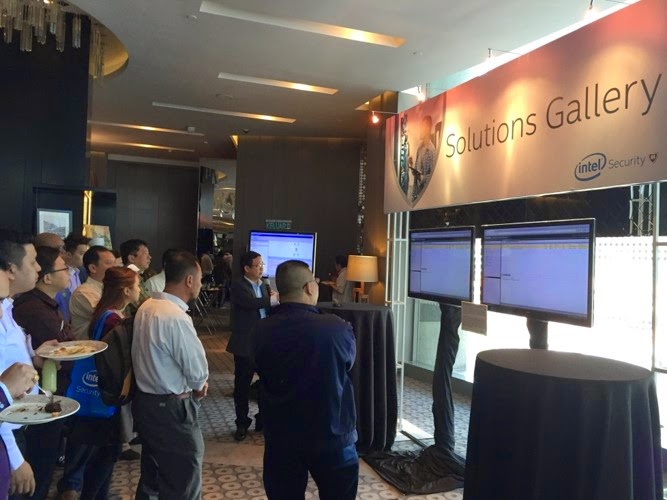
Intel Security demo-ed how it enables customers to have rapid incident response capability from Detection, Validation & Investigation, to Isolation and Remediation. This demo took into consideration Gartner’s paper titled“Designing an Adaptive Security Architecture for Protection From Advanced Attacks” which covers 4 stages – Preventive, Detective, Retrospective and Predictive.
“NGFW : Achieving Full Resiliency”
Today’s businesses demand highly secure, easy to manage, and fully resilient network security solutions that perform in real world environments. Intel Security’s Next Generation Firewall delivers this in a number of proven ways:
•No comprising security for performance – Validated via the Miercom report, performance is minimally impacted as security features are enabled.
•Efficiency with Centralized Management – The McAfee Security Management Console (SMC) is designed for workflow efficiency with a full set of tools that enable administrators to manage the network and services across the whole lifecycle. The SMC streamlines key tasks so that administrators can perform their daily tasks in shorter time, accurately and without human errors.
•Endpoint to Network integration – This new capability enables McAfee Next Generation Firewall (NGFW) to selectively and automatically block network traffic originating from PCs, laptops, servers, file shares, and other endpoint devices based on highly granular endpoint contextual data. McAfee NGFW Application Layer Exfiltration Protection is the only solution that goes beyond next generation firewall solutions to prevent exfiltration of sensitive data from endpoints via unauthorized programs, web applications, users, and communication channels.
•Advanced Threat Ecosystem – Security Connected enables McAfee NGFW to ingest and act upon real-time threat information, improving organizational security postures and defences against advanced threats such as zero-day attacks, evasions, and endpoint-initiated attempts at data exfiltration.
•Proven ROI – As stated in the white paper produced by IDC, organisations using McAfee NGFW are achieving significant IT and business benefits. Intel Security clients have seen many benefits such as an improved user and customer experience, proactive IT operations supporting greater innovation, more reliable business operations driving productivity and revenue and an enhanced business agility.
“APT : Rapid detection and response”
Organisations today face a threat landscape that is changing at a dramatic pace. Operationally, organisations are also facing challenges as current staff is being asked to manage an increasing number of systems coupled with a demand for more information about those systems.
McAfee Active Response delivers continuous detection of and response to advanced security threats to help security practitioners monitor security posture, improve threat detection and expand their incident response capabilities through predictive discovery, detailed live and interactive analysis, forensic investigation, comprehensive reporting and prioritised alerts and actions. All of this power is harnessed via the ePolicy orchestrator, offering unified scalability and extensibility with no need for incremental staff to administer.
Migrating to the cloud without compromising on security
Today’s businesses comprise protection for both physical and virtual environments and Intel Security provides both security sets managed under a single console.
McAfee Server Security combines the discovery and management capabilities that are offered by McAfee ePolicy Orchestrator, DC Connector for AWS, DC Connector for vSphere, DC Connector for OpenStack, and DC Connector for Microsoft Azure which means whether you are running private or public cloud, it protects you for both sets while reducing the operational overhead.
Email Protection with Office 365
Businesses are eagerly embracing the capabilities and flexibility of cloud-enabled Microsoft Office 365, which provides the freedom to work at the office or on the go with nearly any device, but often neglecting security.
By layering McAfee Email Protection on top of Microsoft Office 365 Exchange Online, an organisation gets enterprise-strength security without having to sacrifice flexibility and the productivity advantages of the cloud.
As email is the first point of attack for bad actors, McAfee Email Protection includes Click Protect, which provides URL awareness and protection against evolving, sophisticated phishing tactics.