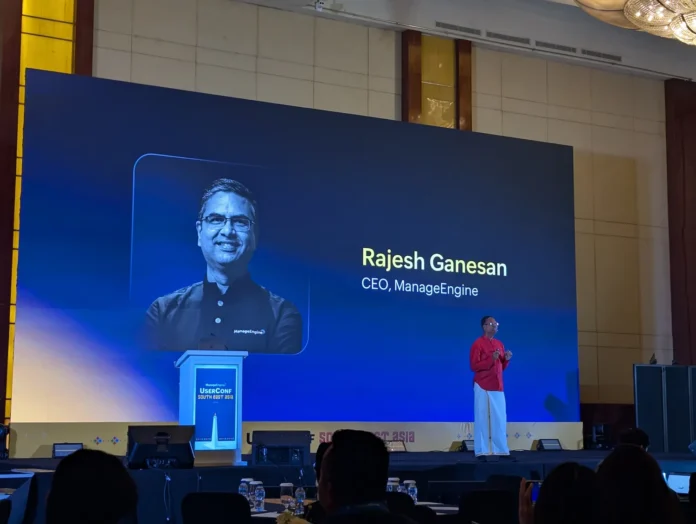
For as long as the industry can remember, enterprise IT was seen as a backroom function – provisioning laptops, keeping the WiFi running, and making sure the corporate network stayed online. Speaking to Enterprise IT News on the sidelines of ManageEngine’s user conference in Jakarta, CEO, Rajesh Ganesan laid out a clear thesis, “Every enterprise today is a digital enterprise. Digital enables and runs businesses today, regardless of size, vertical, or region.”
This demands a very different mindset from IT leadership, one which understands the purpose of technology and aligns IT decisions to that purpose. The CEO noted this is a mindset that ManageEngine’s most successful customer organisations also embrace.
From tech utility to strategic engine
Rajesh traced this shift to the broader digitalisation of business over the years. IT is no longer just “deploying technology” or “supplying devices and connectivity”. Instead, the CIO’s organisation is expected to drive transformation, market expansion and global growth.
You need people, you need leaders with the vision to always bring alignment. Alignment doesn’t happen by itself.
Rajesh Ganesan
“As part of this evolution, we see the CIO’s organisation becoming more and more strategic in terms of how businesses transform themselves, how businesses expand to adjacent markets, how they expand globally, and how to meet business objectives,” he said.
What approach do IT leaders of successful organisations have?
“IT leaders have to first visualise themselves as also business leaders,” he said. “They are not only worried about technology working. They should be worried about the profit and loss of the company, if the employees are happy, if the happy employees are keeping customers happy, if they are growing in their career.”
Alignment doesn’t happen by itself
Rajesh is quick to dismiss the idea that business–IT alignment is some natural byproduct of digitalisation. It is, in his words, “its own challenge, its own struggle”.

For alignment to happen, he believes organisations need leaders with clear vision to bridge business and technology, clear objectives and clarity with purpose, as well as realistic understanding of what technology can and cannot enable.
“You need people, you need leaders with the vision to always bring alignment. Alignment doesn’t happen by itself,” he emphasised.
That clarity starts with a fundamental question: why does the business exist, and consequently, why does the IT function exist?
For ManageEngine, the answer is straightforward.
“We are a technology company. Our business exists to make the lives of our customers simple,” Rajesh said. “And who are our customers? CIOs, CSOs, IT directors, people running network operation centres, people running security operations.”
To do that, he said, ManageEngine must understand its customer organisations’ day-to-day problems, skills and technology challenges – not in the abstract, but in operational reality.
The evolution of a technologist into a CEO
Rajesh agrees with EITN’s observation that his own career mirrors the story he tells about business–IT alignment. Rajesh joined Zoho as a software programmer in 1997 and today oversees not just technology, but the overall business of ManageEngine.
He sees his journey as part of a broader pattern across the industry.
“I started as a programmer, as do many CIOs,” he said. “Some of them evolve to become business leaders, some of them evolve to become technology leaders. That’s been the evolution.”
This suggests that technical depth becomes a foundation, not a ceiling. The modern IT leader leverages that grounding to engage deeply with business outcomes.
It is no longer enough to measure success as how many devices were deployed or how quickly tickets were closed. Besides these, other technology outcomes now matter to the business.
For example, how quickly an external red team can breach a company network and how well the company responds, or whether a certain technology helps employees work better, or is simply adding friction.
While Rajesh acknowledged that domain knowledge in specific industries is “an added advantage” for technology teams, he is clear that business outcomes remain the north star. Business teams will continue to own revenue and market metrics; technology teams must own the security, reliability, and experience that make those outcomes possible.
Convergence of IT and security
When it came time to address the long-standing split between IT operations and security operations, Rajesh insists that “one cannot run without the other.”
He believes there should be a “dotted line” between them and allow clear ownership on both sides without creating silos.
He also acknowledged an often unspoken tension; operations want speed and agility but security is often the “tax” that slows this down.
Yet, he argued, security cannot be an afterthought.
“You cannot blame it on the security tax to let operations run free the way they want. Security cannot be wished away. It has to be a fundamental piece.”
ManageEngine’s response has been to invest equally in IT operations and security technologies, integrating them “tightly” and “contextually” so that they encourage collaboration rather than conflict.
Practising what it preaches
With 18,000 employees in around 30 countries, the company uses its own tools to manage both IT operations and security – an approach he describes as being “customer zero”.
“We consume our own products inside our company,” he said. “When AI agents, security controls, or new tools come into the infrastructure, we have to adopt the same model we preach to customers.”