
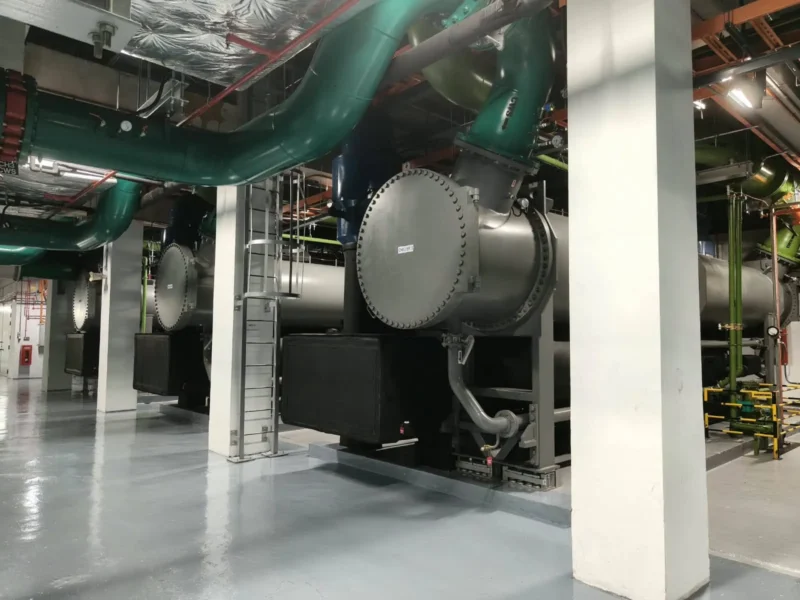
At a press briefing on 3 November 2026, Resorts World Sentosa (RWS) outlined how it had improved plant efficiency from 0.82 in 2012 to approximately 0.635 kilowatts per refrigeration ton in 2025 – an efficiency level that outperforms standard global and local benchmarks. The resort uses two district cooling plants to supply chilled water for air-conditioning across its facilities.
The next challenge is coordinating both plants to respond to air-conditioning needs in real time while preparing for the additional demand expected from the RWS 2.0 expansion.
A strategic co-innovation initiative with Honeywell Technologies will support that work. Building on their 2023 connected-building deployment, the partners will use the resort’s operations to develop and test AI-enabled approaches to energy optimisation.
RWS says it will become Singapore’s first tourism destination to adopt predictive optimisation technologies for district cooling, supporting its ambition to achieve carbon neutrality by 2030.
Beyond individual systems
“The next frontier in building efficiency is not simply automating individual systems such as HVAC [heating, ventilation and air-conditioning], chillers and district energy infrastructure,” said Munish Suri, President, Building Automation, India and APAC, Honeywell Technologies.
“It is enabling interconnected systems to work intelligently together, continuously and proactively optimising energy use as conditions change,” he added.
The partnership covers three programmes:
- Predictive district cooling will forecast demand and determine which equipment should run and when, helping avoid excess chilled-water production.
- AI-enabled air-conditioning, already deployed at Resorts World Convention Centre and Illumination’s Minion Land at Universal Studios Singapore, adjusts operations to reduce energy use while maintaining comfort.
- Honeywell Technologies’ Forge platform will consolidate energy data, identify potential waste and give facilities teams practical recommendations.
The partners will draw on Honeywell Technologies’ Singapore Sustainable Buildings Centre of Excellence, established with support from the Singapore Economic Development Board, to develop and test the technologies.
Where ontology fits
In our Data Centre World Asia coverage, Honeywell Technologies argued that systems should give operators context, rather than more isolated alarms. At RWS, the question is how to structure that context so software can coordinate equipment across the resort.
This is where ontology becomes relevant. It provides a framework for describing equipment and its relationships: which plant a chiller belongs to, what it serves and how it connects to cooling storage. AI can help match equipment records across systems, even when naming conventions differ. Keeping this information current helps optimisation software use the right data and account for how changes to one asset could affect another.
Facilities management goes beyond fixing things when they break. It means staying ahead, using technology to make the resort more comfortable, reliable and efficient for every guest.
Kess Chiang
The panellists discussed whether stored cooling could be used before producing more. That decision requires information about available capacity, expected demand and conditions across both plants. A temperature reading alone is insufficient: software needs to know where it came from and how it relates to the wider system.
Comfort remains the test
Kess Chiang, Senior Vice President, Resort Services, RWS, explained the objective, “Facilities management goes beyond fixing things when they break. It means staying ahead, using technology to make the resort more comfortable, reliable and efficient for every guest.”
He cited room and venue temperatures that respond to humidity, airflow and changing weather rather than fixed settings.
For IT and facilities leaders, this means more than connecting data feeds. Software needs a reliable, current picture of the equipment and how it works together.
RWS said it expects a tenfold return on investment from the initiatives and hopes the collaboration will provide a blueprint for similar projects across Asia and beyond.