
By Charles F Moreira
Virtualisation has helped enterprises consolidate their information processing and storage systems onto fewer platforms and especially since Sun Microsystems was acquired by Oracle Corp. in January 2010, the latter has been able to offer enterprises with a single, virtualised, highly scalable, cloud-enabled platform comprising hardware, operating systems, virtual machines, middleware, applications and database servers and storage which solves the above problems.
“Our value proposition for data centres is a simplified environment, reduced risk, greater performance and fewer pieces of hardware, such as 20 instead of 100 racks as with traditional systems,” said Chua I-Pin, Oracle APAC Services senior director, Systems Line of Business, Malaysia & Thailand.
|
|
|
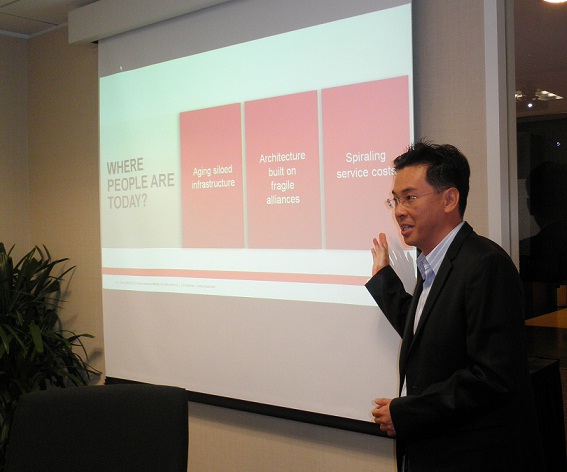
Chua during a briefing at Oracle Malaysia’s office |
Its solutions are based upon the “Think Differently” philosopy of Apple’s late co-founder Steve Jobs, “The Network is the Computer” philosophy of Sun Microsystems co-founder Scott McNealy and the “Hardware & Software Engineering to Work Together” philosophy of Oracle chief executive officer Larry Ellison, which was enabled by Oracle’s acquisition of Sun, as it brought in the former’s hardware expertise.
Its solutions include Oracle’s Linux and Intel x86-based Exadata database appliance announced in 2008 and its Exalogic applications server announced in 2010.
Its flagship is the Sparc Super Cluster announced about two years ago. It’s based on Sparc processors and Solaris operating system, and combines both applications and database servers on a one platform.
The database layer runs 100% Oracle software while the applications layer runs any software which runs on Solaris and together this greatly helps to reduce the “blame game” – a multi-vendor environment of vendors pointing fingers at each other.
“We’ve tested the Sparc Super Cluster’s performance to be 5 to 10 times faster core-to-core than our customers’ existing IT system,” said Chua. “While its price starts at around US$500,000, customers will realise a return on investment within two to three years,” he added..
With that kind of price tag, Oracle mostly targets customers in telecommunications and financial services, and to a lesser extent, government.
The above three platforms’ notable customers include an ASEAN-wide insurance company which uses an Exadata appliance for data warehousing and achieved 36 times faster extract, transfer and load (ETL) performance and 650 time faster report output compared to previously.
Another is an electronics manufacturer in Thailand which performs online transactions processing and realised 17 time more transaction per hour. Third is Softbank Mobile in Japan which replaced its 36 Teradata racks with three Exadata racks.
“Based on our own internal experience of the above platforms, Oracle realised twice the performance of our previous system, reduced our disaster recovery time by 95%, lowered growth in storage requirements by 75%, reduced utility and floor space costs by 50% and saved US$400,000 on third-party software license fees,” said Chua.
The Malaysian scene
Closer to home, cloud computing has been big in Malaysia in the past two years, with service providers launching public cloud services on a pay-per-use basis to customers such as SMEs, which can’t afford their own private cloud.
However, Chua is doubtful as to whether local public cloud service providers can compete on price with the Amazon Elastic Compute Cloud (Amazon EC2) due to the latter’s better economies of scale.
“Cloud-based systems, whether private or public, let its operator meter resource use and is flexible and enterprises with over 100 servers need to have a cloud,” said Chua. “However, enterprise data centres worldwide are not 100% cloud-based (private cloud) and still have legacy silos,” he added.