

By Charles F Moreira
Interest in cloud computing continues to grow across the Asia Pacific, according to the VMware Cloud Index 2012, announced by VMware country manager Laurence Si at the VMware Solution Symposium 2012 in Petaling Jaya on 1 November, 2012. The third in the annual series, the Index is based upon results of an online survey conducted in September and October by Forrester Consulting and ITR, of about 6,500 senior IT practitioners in multinational, local and region companies, and public sector organisations across 11 Asia Pacific countries including Japan.

Key drivers of cloud adoption in the region are to enable business to optimise IT, to reduce costs and to supplement a mobile and flexible workforce. Top concerns or barriers to cloud adoption are data privacy (69%), security for application development (64%) and unsanctioned buying of software-as-a-service (SaaS) by businesses within their organisation besides the IT department.

Cloud adoption across the region had grown steadily from 24% in 2010 to 42% in 2012. Of 4,799 respondents, 42% said their organisation has a cloud initiative in place, 33% said it is currently planning an initiative while 26% said it has no plans yet. The corresponding percentages for Malaysia are 36%, 40% and 24% respectively, compared to 58%, 20% and 21% in Australia and 51%, 33% and 16% in Singapore, while 70% of organisations in Malaysia would adopt either private or hybrid clouds. Forty three per cent believe that the organisation is more likely to invest time, money and skills on public cloud, 11% on public cloud and 31% on hybrid cloud – i.e. private for some applications and public for others. Sixty per cent agreed that their IT services successfully managed the use of cloud-based services within their organisation, based upon those who rated its achievement six or more on a scale of 1 to 10. 55% agreed that the organisation was spending more to train their IT staff to support cloud initiatives, while 49% agreed their organisation actively sought to hire IT staff with cloud computing expertise.

Seventy five per cent believe that cloud computing will optimise their existing IT management and automation capabilities, 73% that it would empower the business by simplifying access to IT resources, 70% that it would support a more mobile and flexible workforce, 70% that it would reduce IT costs and 69% believe it will make their organisation more competitive. However,only 59% believe it will help their organisation deploy a whole new generation of applications. The majority – I.e. 81% rated having a virtualised IT infrastructure as important to enabling cloud computing, based upon those who ranked it 7 or more on a scale of 1 to 10. However, this proportion is down from 83% in previous years. Equally important is security and isolation (81%), followed by service levels of 99% or more uptime (80%), seamless integration of cloud solutions with existing on-premises IT systems (79%), dynamic provisioning or capacity on-demand (also 79%), though 69% ranked a pay-per-use model as important. Meanwhile, of 4,954 respondents, 65% believe Asia Pacific organisations have a strong understanding of cloud computing, based upon rankings of 7 to 10, which is up from 61% last year, while 60% believe their IT division is ready to run their company’s most strategic applications in the cloud, 74% saw cloud as a top priority or highly relevant to their organisation. This proportion was higher at 88% in organisations with 10,000 or more employees and as low as 68% in organisations with less than 500 staff.
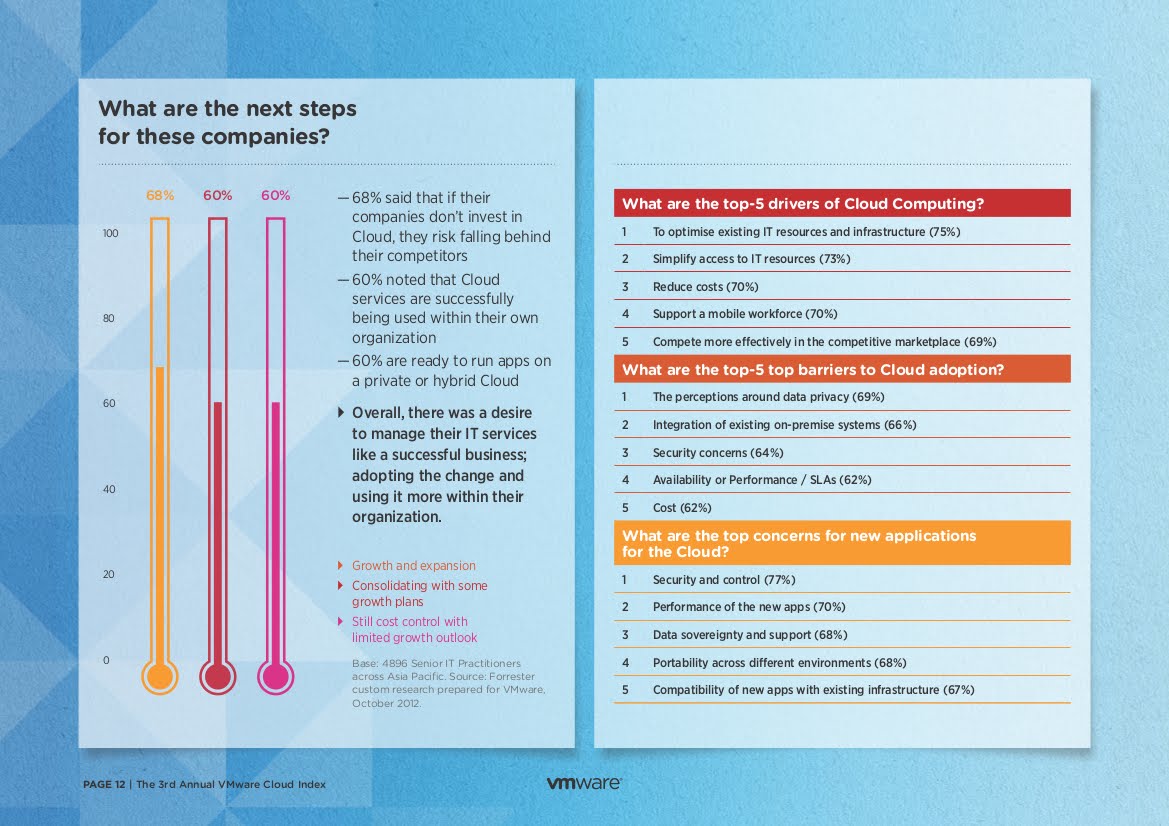
The majority – i.e.80% believe cloud can help their company compete more effectively, while 68% believe that failing to embrace cloud would adversely affect their organisation’s competitiveness.
On the Malaysian front

Zooming in on Malaysia, 54% believe that their organisation would fall behind its competitors if it did not embrace cloud. Businesses in Malaysia are fast-tracking their optimisation plans, with adoption having grown steadily from 21% in 2010 to 36% in 2012. Seventy six per cent altogether either have or are planning a cloud initiative, compared to a 74% regional average, while 36% are current users, up from 28% and 21% respectively in 2011 and 2010.. However, optimism in their organisation’s current business outlook is low,with 34% who say it’s focused on growth and expansion compared to 51% on average across the region,though professional interest in cloud is strong,with 76% who believe that it would make their job less complex. Fifty six per cent of respondents believe their organisation currently has the rights skills and infrastructure to create and manage a private cloud, but only 19% believe their IT department is successfully managing the usage of cloud-based services within the organisation.

Michael Barnes, Forrester vice-president and research director for vendor strategy professionals explained this low confidence in their IT department is not fully adopting the potential business value of cloud computing, perhaps due to some companies fearing that would lose control of their cloud, especially when it’s open up to public cloud services. Respondents in Malaysia, as well as Thailand and Indonesia are unique in that they cited reliable and affordable broadband connections as a key concern and barrier to cloud adoption. Reliable and affordable broadband was the third top concern in Malaysia. The top concern was data privacy, residency or control, followed by security.

Access to affordable and reliable broadband was the top concern in Indonesia and Thailand, followed by data privacy, residency or control in both countries. Third in Indonesia was security, while in Thailand it was integration with existing systems. The top three drivers of cloud in Malaysia are support for mobile and a flexible workforce, optimisation of existing IT management and automation, and simplification of IT access.

The top three drivers in Indonesia are optimisation of existing IT management and automation, simplification of IT access and to ensure they only pay for IT use, while in Thailand they are simplification of IT access, optimisation of existing IT management and automation, and only pay for IT use. Cloud adoption in Indonesia is estimated to grow to 70% in 2014 from 41% in 2012, while in Thailand it had grown from 21% in 2010 to 31% now, down from 32% in 2011. Between 2010 and 2012, cloud adoption grew from 31% to 58% in Australia, 16% to 31% in China, from 27% to 50% in India, 43% to 58% in Japan and 23% to 51% in Singapore. It was 36% in Hong Kong in 2012, grew from 24% in 2011 to 32% in 2012 in South Korea and was 44% in Taiwan in 2012. It’s interesting to note here that despite South Korea, Hong Kong and Taiwan having excellent broadband connectivity and in general more developed and affluent, cloud adoption is lower in these three countries, compared to India and Indonesia where broadband connectivity is relatively lower and which are generally less developed and less affluent societies. Sixty four per cent of respondents in Malaysia expect cloud to increase the role and importance of hosting service providers such as telecommunication network operators and hosted service providers within their organisation.