

By Charles F. Moreira
From part 1 of our EITN FSI roundtable report, we’ve seen what big data means to different technology vendors in the FSI industry. From a banker’s point of view, more specifically, Alain Boey, Bank Simpanan Nasional (BSN), Senior Vice President and Head of Management Transformation Office, big data affects FSI operations mostly in areas of mobile banking, where banks provide an increasing number of mobile services to customers to access on their handhelds.
BSN also generates big data, for example in the case of field agents who sign up customers, process loan applications and provide other financial services in outlying areas where there are no physical bank branches.
Even capital markets player Bursa Malaysia is affected by big data. Its Head of Post Trade Services, Technology and Systems, Dennis Foong said, “The time for data to be ready is critical and must be in real-time as FSI players find it important to be able to link their businesses and technological perspectives.”
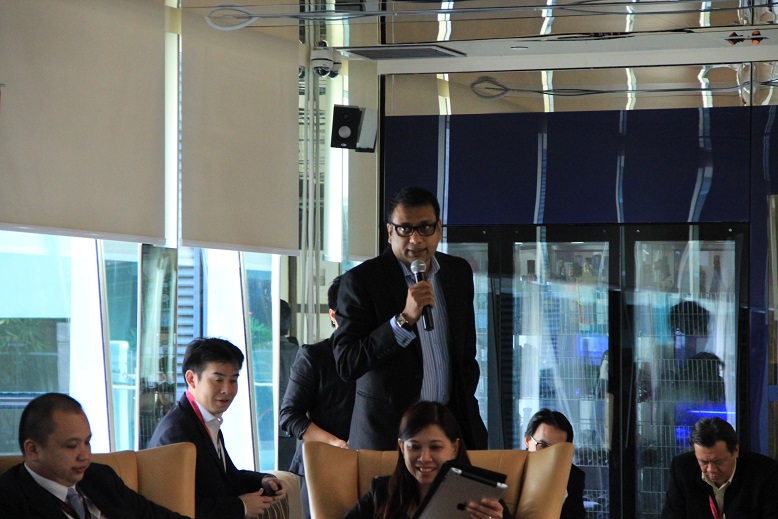 |
| Gartner Malaysia’s Country Manager, Mano Govindaraju gives his opening remarks |
But how do big data scenarios like the above impact the various functions/operations at the back-end, that FSIs have to deal with, daily?
We continue with roundtable panelists’ further thoughts:
 |
| EITN Managing Director Debbie Wang welcomes panelists and roundtable guests |
TIME dotCom’s (TdC) Adrian Lim said, “TdC positions itself as an enabler for FSI data centre connectivity, and whether it is an in-sourced or out-sourced data centre for an FSI, we provide robust, high-ability network to support a ‘single platform’ for the FSI.”
Connectivity is usually the invisible underlying technology that is taken for granted, but not all connectivity is created equal, or even managed equal.
Lim described, that the operator’s networks are designed to be very robust with 99.999% availability for FSIs. For example, TdC’s network employs mesh topologies, are hardened against distributed denial of service (DDoS), as well as have other security features incorporated in.
Managed transfer
In part 1, Seeburger’s James Hatcher had shared opinions about the 3 main interaction points where big data is generated: Human-to-Human, Human-to-System and System-to-System. He further added, “Achieving data security is harder with big data when it involves unstructured data. For example, in a case of fraud worth US$40 million, where the weakest link usually is in the Human-to-Human interaction.
“People usually don’t think about needing Seeburger until there is a problem. We are like the plumbing guys, who for example, integrate a bank to a stockbroker and provide data integration so that the banks can work with the traders to deal with real-time trading accounts rather than clearing accounts (that can be manipulated),” said Hatcher.
Pertinent infrastructure issues
While all this is happening, infrastructure still underpins everything that an organisation does with big data.
Because of the velocity of growth of the various types of voluminous data, availability of data becomes critical. Schneider Electric’s David Blumanis explained that the redundancy around the data, for example the infrastructure to store, access and manage data, becomes important too.
He added, “In the FSI industry, actually a lot of waste is happening in data centres where up to 50% of capacity and resources are set aside for redundancy purposes, which is why FSIs are thinking more about investing into data centre technologies and solutions that can enable automation to make power, cooling, sizing, capacity and energy usage work better in tandem (with each other).”
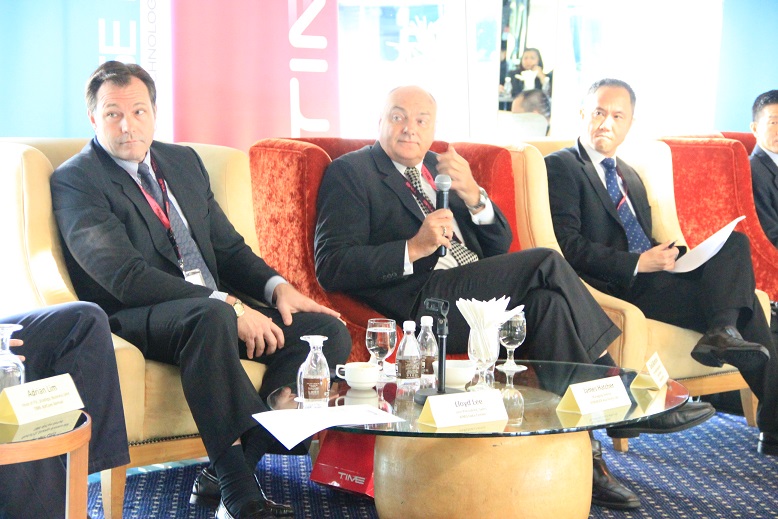 |
| (L-R): James Hatcher, David Blumanis, Eric Lam |
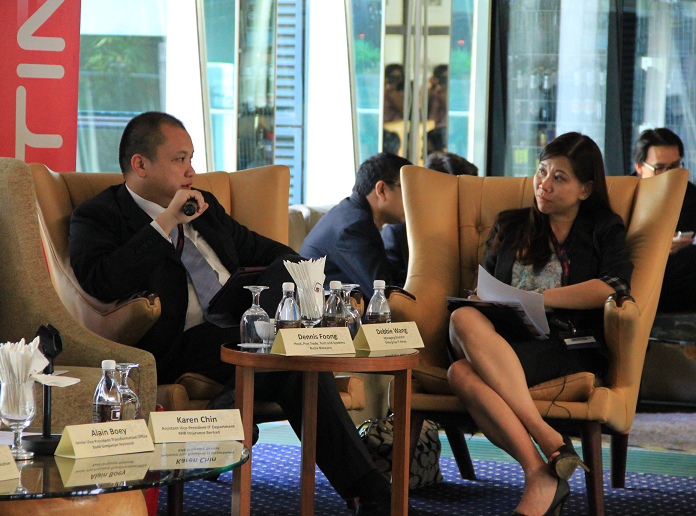 |
| Dennis Foong with Debbie |
He had also observed how the energy costs for FSIs are increasing dramatically. OPEX cost for Malaysian FSIs are going up by 25-30% and the data centre contributes a big part of this cost.
Banks also want to be sustainable and are trying to address energy usage, currently.
Higher density computing (more compute power in the same footprint size) is creating lots of change in networks, virtualisation and servers. “This involves design of data centres to be future-proof, while FSIs need to look at it from a total cost of ownership (TCO) point of view, “ said Blumanis.
What to outsource, what to keep in-house
There is way much more data than before, and it won’t stop growing any time soon. Sure enough, AIMS Data Center’s Lloyd Lee sees double digit growth in demand for storage capacity and power for data processing.
Being carrier neutral is an advantage for AIMS, as having more than one carrier to fall back upon insures against network disruption. Same as TdC, AIMS has also specifically designed countermeasures against distributed denial of service (DDoS) attacks which attempt to disrupt delivery of an FSIs service by overwhelming its website with requests.
“Traditionally, most FSI in Malaysia prefer to host their data centre operations internally, unlike their foreign counterparts who prefer to outsource their data centre,” he observed.
Blumanis even shared a trend he observed whereby more ‘creative’ international FSI players become anchor tenant to co-location data centres. In turn, co-location data centre players are looking to drive new design solutions in their new facilities.
“Thus, they (FSIs) become the funder, which helps to build and finance the data centre, and this tends to gives them bigger ‘control’ over cost, operations, access and data security.” He had also shared that co-location designs become intellectual property to convince potential customers to use their facilities because of the higher level of ‘quality of service’ and ‘energy-efficiency.’
Hatcher also finds that majority of banks own their own data centre, but they would outsource other functions, say, data management and connectivity of that data centre, to other parties.
He observed, “FSIs tend to have many custom-coded applications, and often face problems when different FSIs are merging (because of regional expansion through acquisitions) and these applications need to be integrated into the core default system.
“There are also many FSI open source systems and applications which need to be maintained. Industry standard software is the only way to upgrade applications across systems, but unfortunately …many FSI still prefer to have custom designed banking applications to fit their special function operations,” Hatcher said.
The other end of the spectrum
TdC’s Adrian Lim had shared that as more banks reduce branches and begin to offer banking and financial services via the Internet, outsourcing those services to be handled by a third-party would be more prevalent.
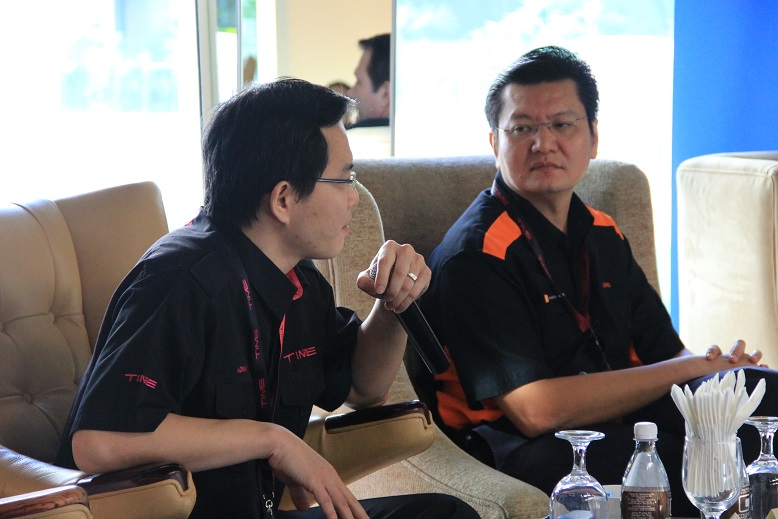 |
| (L-R): Adrian Lim and Lloyd Lee |
The FSIs however are keeping a tight rein of what they outsource.
BSN’s Boey said, “The central bank, Bank Negara Malaysia, has already set out what can be outsourced and what cannot, so as an FSI, BSN does not have much say but can still outsource for example, test systems.”
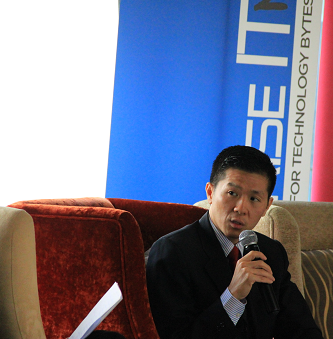 |
| Alain Boey |
Even so, Bursa Malaysia and BSN recognise the value of big data. For BSN, Boey shared, “Customers don’t walk into bank branches anymore. Instead today it’s all about ‘relationship banking’ …so FSIs are always thinking of ways to use big data to enhance the relationship with their customers for better ‘stickiness.”
Bursa Malaysia’s Foong said, “The current trend of regionalisation in FSI industry requires the profiling of foreign investors. To advocate borderless trading, Bursa hopes to use big data for profiling to obtain a better match between foreign investors with local opportunities.”
Fraud prevention
As an IT security provider, RSA’s job is to ensure that the FSI players can accurately identify their users – are they are who they say they are?
“In my division of RSA, covering IT Security for Fraud prevention, FSI makes up 70% of the business,” said RSA Asia Pacific’s Eric Lam.
“The bad guys are very organised and well financed. They are stealthy, have very sophisticated tools and target mostly FSIs – where it is a combination hub of data, funds and transactions,” he added.
With regards fraud, Bank Negara has required that effective 1 May, 2013, the cost of all interbank transactions are reduced to 30sen, and from next year, the cost of processing business cheques is increased to RM6; and all these new cost regulation can only drive customers towards more mobile and Internet transactions.
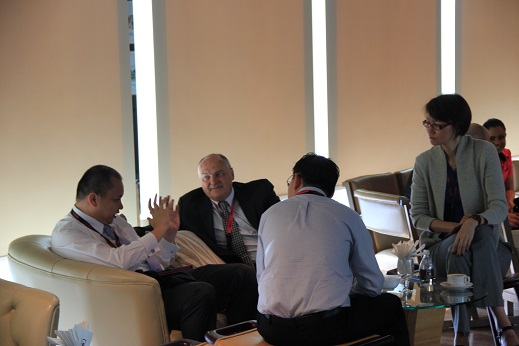 |
| An impromptu roundtable going on, before the real roundtable started |
Bursa Malaysia’s Foong correctly surmised when he said, “FSI fraud is evolving into more permutations.”
Lam had something to say about where he thought fraud is heading. “The equivalent of a physical stick-up bank robbery is card skimming and duplication, while Internet banking brought about account takeover fraud. And now mobile banking brings about new forms of fraud.
“Regionalisation also means that FSIs needs to work in unfamiliar territory and markets where they are not familiar with their new users. Their customers are no longer the same anymore, while fraudulent behaviour and alerts are not the same either.”
Despite all this, the public at large has to be educated about the risks out there.
“Awareness is very important, since users, despite their background or level of education, are also susceptible to fraud,” Boey concluded.