Join our community and be part of the conversation.
To subscribe, simply enter your email address on our website or click the subscribe button below. Don't worry, we respect your privacy and won't spam your inbox. Your information is safe with us.
It was dubbed the first ever integrated event IBM has ever had; members from all of its different product teams and brands were there. It was also ‘the biggest ever event IBM has had in Asia’ with around 2500 attendees.
IBM applied a little basic analytics and later shared stats that 85% of these were decision makers, 38% were members of C-suites and 46% were senior execs.
Besides all that, here is what I found out during the 4 hours I was present at IBM’s InterConnect 2012.
Mobile first
Mobility is important for IBM. A quick Google search and a little chat over breakfast with Marie Wieck, GM for IBM Software Group’s application and integration middleware, revealed that the tech company plans to have a mobile version of as many of their apps as they possibly can. In fact, if there was a silent, invisible undercurrent to the whole InterConnect event, mobility is it.
IBM had launched Mobile Foundation last April, a pretty comprehensive portfolio of software and services that Wieck said tries to address the challenges of consistent user experiences. The mobile market is too fragmented right now, with too many OSes and device shapes and sizes for developers to build for.
On the management and access side of things, IT departments are facing challenges trying to integrate all the differing mobile devices into their business’s IT backend, as well as provision and deploy apps to their workforce and customers, respectively.
Their recent HTML5 development acquisition, Worklight, fuels IBM’s ambition to reduce an application’s time to market, cost and complexity, with security and analytics built-in as well. Their Cast Iron technology then provides integration at the backend, enabling apps to be cloud-based.
With Mobile Foundation, IBM’s investments into mobility have tripled, and Wieck admitted that they are far from done investing in the enterprise mobility space.
A little tidbit from IBM’s own mobility story: they support a pretty wide range of mobile operating systems in their organisation, including even Palm!
Here we go again
EITN briefly talked about Oracle’s engineered systems last week courtesy of their big event in San Francisco. These vertical stack solutions aim to reduce deployment times by offering pre-integration or at least a reference architecture that takes the bulk of guesswork out of implementations.
Businesses can say good bye to months of provisioning and integrating servers/storage/ networks when an application needs to be deployed. That would be done for them. Just slap on the application on the top layer, hook it up to the rest of their IT environment and businesses are good to go.
From memory, I first heard of the vertically integrated stack, thanks to VMware, Cisco and EMC and their VCE block solution. What they offered was a blueprint of how to integrate 3 components: VMware’s hypervisors, Cisco’s networking tech and EMC’s storage. This was about two years ago.
Since then, there have been many ‘interpretations’ and configurations of the vertical stack solution. So much so that analyst and research companies, haven’t been able to properly agree on the components that a typical vertical stack (for research purposes), should comprise of. Some tech vendors have more components, others have less and yet others have components that the rest do not have.
So, you can imagine the conundrum.
An informal chat with another Gartner analyst (who shall remain unnamed) over drinks revealed that a report (hopefully with numbers and market share and whatnot) is due out in 6 months.
What shall that report reveal? Is there any one vendor leading in market share? Is there any growth in this particular space that it’d register on analyst radars in first place? Oracle claimed triple digit growth, but 100% of 1 would still be an insignificant blip.
As of now, it had only been disclosed that 2 vendors have the most number of components in the integrated vertical stack – Oracle and IBM.
We’ve already heard from Oracle. What does IBM say?
Expert versus Engineered
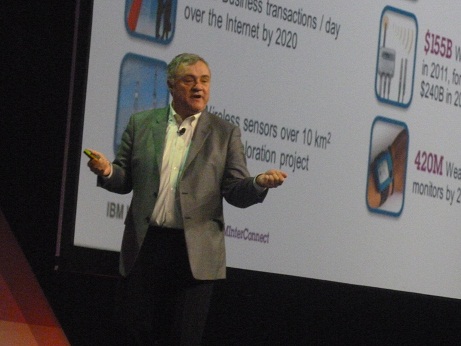
Steve Mills, IBM’s senior VP for IBM software and systems group described, “It is clear that customers around the world, whatever the size of market, are struggling with time it takes to implement IT and enterprise systems… customers are saying it is taking too much time, energy and labour.
Steve Mills at IBM InterConnect 2012: Sharing unique perspectives from conversations with customers
“So, IBM wants to do a better job of the prepackaged systems approach.”
While they want to maintain choice and customised configurations, Mills admitted they can’t deliver everything that customers want, because the market is simply too big. What IBM can do however, is address the different core functions in each different industry.
“Dense, single-rack systems that is scalable and adaptable, is a compelling idea already,” Mills observed of customer receptivity, further adding that for customers, server/storage/networking in a single package is already significant value improvement to the typical approach of buying separate and trying to integrate.
When compared to other vertical packaged solutions, Mills also said, “What we do is fairly unique. Others are often around a restricted model. It has to be their way instead of the customer’s way.
“We are not dictating to them what their software choices are. We support Linux and Windows and all the popular hypervisors.” IBM also touts a common management, administration and control panel – a single pane of glass to view- which sits on top of all the different architectures at the same time.
Mills pointed out that Oracle’s claims of much higher performances is due to solid state disks and near memory performance, not because of “…anything special that they have done technically.
“Their (solutions are built based) around the idea of benefitting Oracle so customers keep buying more Oracle at high price!”
Liking their chances?
The main challenge of time-to-value still remains and IBM recognises that the key value is applications. “Customers are looking for outcomes and results. Apps deliver that.”
IBM had embarked on a big ISV program earlier this year and over 200 have signed up. Mills shared that they are in various stages of implementations and verifying apps from the likes of SAP, Kingdee and Infor for the environment. “Over the next quarter, we expect to see them declare they are able to deliver in prepackaged way on top of the system.”
Mills is cautious about the overall market for these ‘new’ type of systems. “There are over 32 million servers deployed globally today. It’s an evolution to prepackaged systems; the whole market will not move to it. In parts of the world, where lack of skills is a challenge, it will be interesting to see how it pans out.”
Cat Yong is Editor-in-Chief of Enterprise IT News, a regional news website which began in Malaysia circa 2011. A common theme in all of her work - opinions, analysis, features and more - is how technology and innovation drives business and outcomes.
A career tech journalist for 22 years, her work has evolved to also encompass narratives of tech powering human potential.