
By Cat Yong
More and more businesses are doing it for themselves – offering their own bits of solutions to plug into their existing offerings to make it more complete. In some ways, they are slowly transforming themselves into one-stop shops. But they also increase competition.
In the area of technology, Microsoft and Avaya are two rather recent examples – Avaya bundles their unified communications products with acquired backend network tech and offer it to customers as a solution with guaranteed service quality. Microsoft comes out of full software-making mode and starts to produce their own tablet hardware, saying they would know best about how to optimise the software for it.
Many other tech companies do the same thing in their own various ways with many different versions of value-adding ‘services’ (VAS).
Oracle is another example of a tech company that seeks to add the values of Optimisation and Guarantee to their solutions, optimisation and guarantee being just two of various compelling reasons for them to have engineered their own vertically-integrated server, storage and database systems.
The Oracle pitch
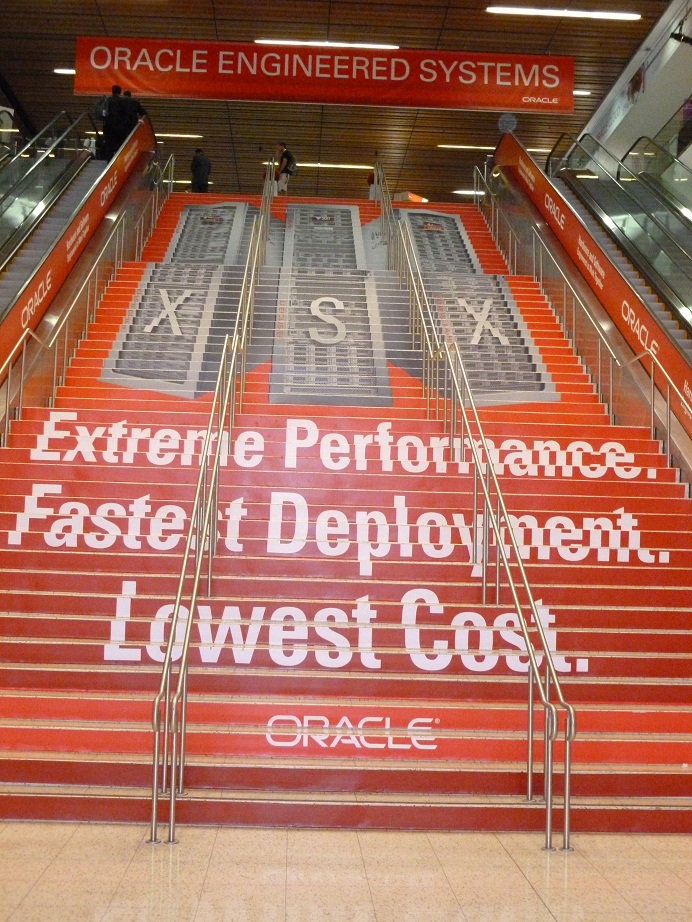
During Oracle Open World 2012, co-president Mark Hurd claimed these single solution stacks or ‘engineered systems’ as being the best-of-breed at every layer – storage, servers, virtual machines, operating systems, databases, middleware and apps. He hadn’t even begun to talk about integration of Xsigo capabilities. Xsigo is the networking company they acquired last July and more announcements are expected to come in by November.
(Side note about storage: Joe Tucci the president of storage company EMC, and his entourage of execs were also present at OOW, keynoting about flash storage and how “…flash will have profound impact on data centres.” Their ‘Human Face of Big Data’ event in Singapore even got some airtime).
Hurd had also added that part of Oracle’s strategy is “…to be open and fit into heterogenous environments and to help our customers build out their IT infrastructures.
“You might think of that as historically, what Oracle has done – sell into a federated environment and have a high-level of enterprise fit, in multi-vendor environments.”
Hurd had said, “There will be customers like Salesforce.com who will also be competitors. But Oracle is going to use Oracle hardware to differentiate at the application layer.”
For example, when it comes to delivering Oracle software, apparently there is 100 times faster performance with their own Exadata X2 database hardware. Their software is also built in a way so that it can be implemented modularly and there is no need for rip and replace.
All of these plus deployment times of weeks instead of months, have end-to-end Oracle support wrapped around it that responds with service in as little as 5 minutes, 24/7 fault monitoring and patch deployment services.
All’s peachy, no?
A short session with analysts from IDC and Gartner revealed further insights. Without specifically naming names, they opined that switching vendors is typically a long-term discussion, as businesses still try to squeeze more ROI out from existing investments.
However, Gartner managing VP, Matt Boon admitted, “There is a lot of interest in APAC for single stack solutions,” but unless vendors can articulate the very obvious benefits of their vertical stack solutions versus the concerns that customers have, it will all come to naught. Vendor lock-in and severe shortage of IT skills like cloud architects, data scientists and business analysts for example, are very real concerns for customers.
“Potential customers understand the benefits of single stack systems, but are still thinking long and hard about it,” said Boon. Even vendors know this and a few like Dell and Cisco have acquired technologies or partners to be able to offer it.
Despite this, there isn’t any concrete data about market share in the industry and IDC’s Sandra Ng explained that the many different ways that converged or integrated vertical stacks are designed makes it difficult to gather data to be compared.
Oracle APAC: Liking their chances
In Asia Pacific, Oracle finds the biggest issue CIOs have to try solve is switching around the innovation versus maintenance spending ratio from 30:70 to 70:30. The company believes they can do this via simpler IT with their engineered systems.
Senior vice president of hardware sales in APAC, Adrian Jones said, “We believe we can give the solution that gives CIOs peace of mind at night,” also adding that they have had customers who buy their end-to-end stack.
“Every CIO has some form of Oracle software in their environment,” shared Jones.
This substantial install base of middleware and Fusion applications does provide opportunity to expand further with their hardware and for the region at least, Oracle has announced bundled offers built around x86, entry-level SPARC servers and storage at the OS, virtualisation and application layers, which enable customers to drive consolidation and virtualisation.
These cater to businesses starting from SMB level, cost 1/3 of offerings from competitors and potentially deploys in less than 2 hours. This Oracle-led initiative for partners further builds out more Oracle-based platforms via which more Oracle solutions can be enabled with other vendors’ solutions in the pipeline too.
Jones added, “Will we get everyone? Maybe not. But we’d like to try.”
Other OOW ’12 reports by EITN
* First thoughts on OOW ’12: The Importance of Playing Nice
* OOW ’12 Announcements: Cloud, Cloud… Oh, And Partners Too
* The Oracle Cloud Strategy: A Friendly Approach
Enterprise IT News was in San Francisco as Oracle’s guest to Oracle Open World 2012 from September 29th till October 4th.