Join our community and be part of the conversation.
To subscribe, simply enter your email address on our website or click the subscribe button below. Don't worry, we respect your privacy and won't spam your inbox. Your information is safe with us.
Scaling AI: The last mile and agent-human orchestration
2026 could be the year that CIOs take seriously and plan for (if they haven't already) the standards and governance of agents they will deploy in their enterprises.
During an online AI strategy briefing, Salesforce’s AI leaders explained why the last mile is so crucial for enterprise customers to see value as they scale deployments.
With experience gained from helping over 18,500 businesses harness agentic AI, Salesforce’s SVP and COO of Agentforce, as well as the president and CTO of engineering framed why the company’s Agentforce 360 platform may be the answer to that critical last mile.
The Last Mile
According to Salesforce, the “last mile” means the critical gap between a model’s reasoning and a company actually seeing a business result.
It also means having to answer everything that is required to turn powerful large language models or LLMs into safe, reliable, and business-ready agents at scale.
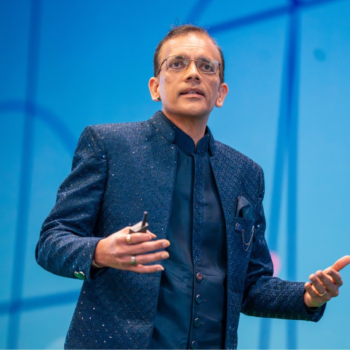
Muralidhar Krishnaprasad
According to Salesforce, the company has already burned through three trillion tokens, closed over 18,000 deals and reached over half a billion dollars run rate on its AI offerings. “We learned a lot – what it takes to move something from just a pure LLM to making it work in the enterprise. That is what we call the last mile,” said Muralidhar Krishnaprasad, President and CTO of Engineering.
He also said, ““LLMs are kind of like a nuclear reactor. It can produce a lot of energy… but unless you have that last mile to harness that energy… you’re not going to get benefit from it. In fact, you’re just going to burn your home if you just connect it directly.”
Context, control, observability, and orchestration are the four components that push LLM demos to enterprise-level outcomes, and the Agentforce 360 platform is Salesforce’s answer to addressing each pillar.
The four pillars of Agentforce
Madhav Thattai, SVP and COO of Agentforce, Salesforce, emphasised that context is the first and most fundamental challenge to scale AI.
Madhav Thattai
“When we think about context, it’s a lot more than just data and content,” Madhav said “It’s about really making sure the right content is available to create an accurate experience for a customer, but also a rich experience that really enhances the level of personalisation.”
For example, Williams-Sonoma, a large retailer in North America, found it challenging to turn their massive product catalogue into personal and relevant online experiences. The Agentforce platform armed AI agents across different use cases, with richer context so that these agents could handle discovery and recommendations that were tailored.
We leverage the creative expression and capabilities of LLMs, but we pair it with deterministic process execution.
Madhav Thattai
For the control pillar, Madhav described a “hybrid reasoning” approach that combines LLM flexibility with deterministic process steps. “We leverage the creative expression and capabilities of LLMs, but we pair it with deterministic process execution,” he said, explaining that agents have to execute the exact same way every single time, especially in regulated industries like healthcare and financial services.
“LLMs, of course, hallucinate, and hence by definition they are probabilistic and non-deterministic. And so we think we need a combination of LLMs and deterministic processes to really run the enterprise logic.”
He highlighted the example of Adecco, a staffing and workforce solutions company that uses an AI agent to qualify job candidates through a 30-step process that must be executed consistently.
From POCs to production
Madhav cited Grupo Falabella, another retailer with over 36 million customers that used Agentforce on Whatsapp to handle hundreds of thousands of interactions like FAQs and order status inquiries. “Observability is what gets (POCs) to production. You need to understand whether the agent is performing, what you need to improve, whether policies need to change, or if you need to have more content.”
The organisation also acknowledged work that currently encompasses various systems and apps in an enterprise, now has to encompass agents and humans working together. Madhav referred to RBC, a wealth management company, that used agentic technology to ready its wealth managers for portfolio conversations.
“It’s not just about agents running (around in your environment). You want your sales agents to be able to create leads in your sales [cloud]… you want your Slack agents to be giving you the summaries of your next meeting… we have blended [agent tech] with our platform in terms of data, metadata and our applications.”
Madhav also described it as a very tight collaboration between an agent and a human. We want to make sure that that collaboration is seamless, that it is orchestrated, all optimising the outcome that RBC wants to drive.”
Where should CIO efforts focus in 2026?
Madhav was explicit that the biggest blocker isn’t tech, but a lack of a clear business goal.
“If people use agents just for the sake of using agents… that is not a good approach. What we want is customers to really orient towards what is the KPI? What is the metric? What is the outcome they are driving? Those customers tend to be very successful.”
In the next 12 to 18 months, there is also anticipation for agentic technology to boom in adoption. “We are going to have a plethora of agents, probably millions of agents… How do you pick the right one? And how do you make sure you orchestrate?” he asked.
2026 could be the year that CIOs take seriously and plan for (if they haven’t already) the standards and governance of agents they will deploy in their enterprises.
Cat Yong is Editor-in-Chief of Enterprise IT News, a regional news website which began in Malaysia circa 2011. A common theme in all of her work - opinions, analysis, features and more - is how technology and innovation drives business and outcomes.
A career tech journalist for 22 years, her work has evolved to also encompass narratives of tech powering human potential.