By Cat Yong
Research has shown that as flash-based SSD progresses, data errors will increase, as will issues with read and write latency. It was also discovered that it won’t be viable for SSDs to go past 6.5nm, and that the year 2024 will spell its end, as the trade-offs that come with the evolution of SSD just overwhelms the benefits of newer versions.
Seemingly impervious to the failings of SSDs, analyst organisations like Ovum also still continue to predict a rosy future for SSDs. For 2013, the analyst company said, “Flash memory is already widely deployed in data centres, and is continuing to change storage systems. The number of options for using flash in data centres is growing, and the technology could be a disruptive force that could unseat some storage incumbents if they do not move quickly enough to embrace it.”
What the ‘Ovum 2013 trends to watch’ did not cover was how SSDs would be doomed if storage players did not innovate or at least try to address inherent failings of the technology. All the near-hype about flash memory and SSDs in light of fast growing big data it will have to store very, very quickly in order to keep up, is dominating news headlines instead.
Controlled fine-tuning
So far, only Hitachi Data Systems seems to be approaching that technology cautiously and meticulously, having realised early on SSD’s weaknesses in enterprise environments, specifically. This has had them rethink their flash storage solutions offerings, and the result of that was HitachiAccelerated Flash Storage which launched in early November.

Dubbed a milestone achievement by Hu Yoshida, VP and CTO of HDS, he further explained that the “solid state drive (SSD) market in 2012 slowed down, and vendors aren’t making money.”
This is in contrast to glowing 2011 predictions that SSD growth would double.
And it has. Just not for the enterprise space.
Hu said, “SSD vendors used to make SSDs for the personal computer (PC) market; SSD solutions as well have primarily catered to PCs… this makes it sit not so well in enterprise solutions.”
For example, besides costing 10x more than HDDs, SSDs are not as durable (ie. limited writes before it wears out), and performance could fluctuate anyway from 100,000 IOPs to 100 IOPs.
“SSD vendors made SSDs for the PC market because that is where the volume is, about less than 5% are shipped for enterprise solutions instead.”
The HDS point of view
Building their own embedded multi-core flash controller was central to their new offering being able to address most of flash technology’s weakness. What enterprise environments have had to work with before were low-cost, single core, low-powered controllers which is acceptable for PCs, but in enterprise data centres where SSD capacities are into the terabytes range, these controllers are just not sufficiently powered.
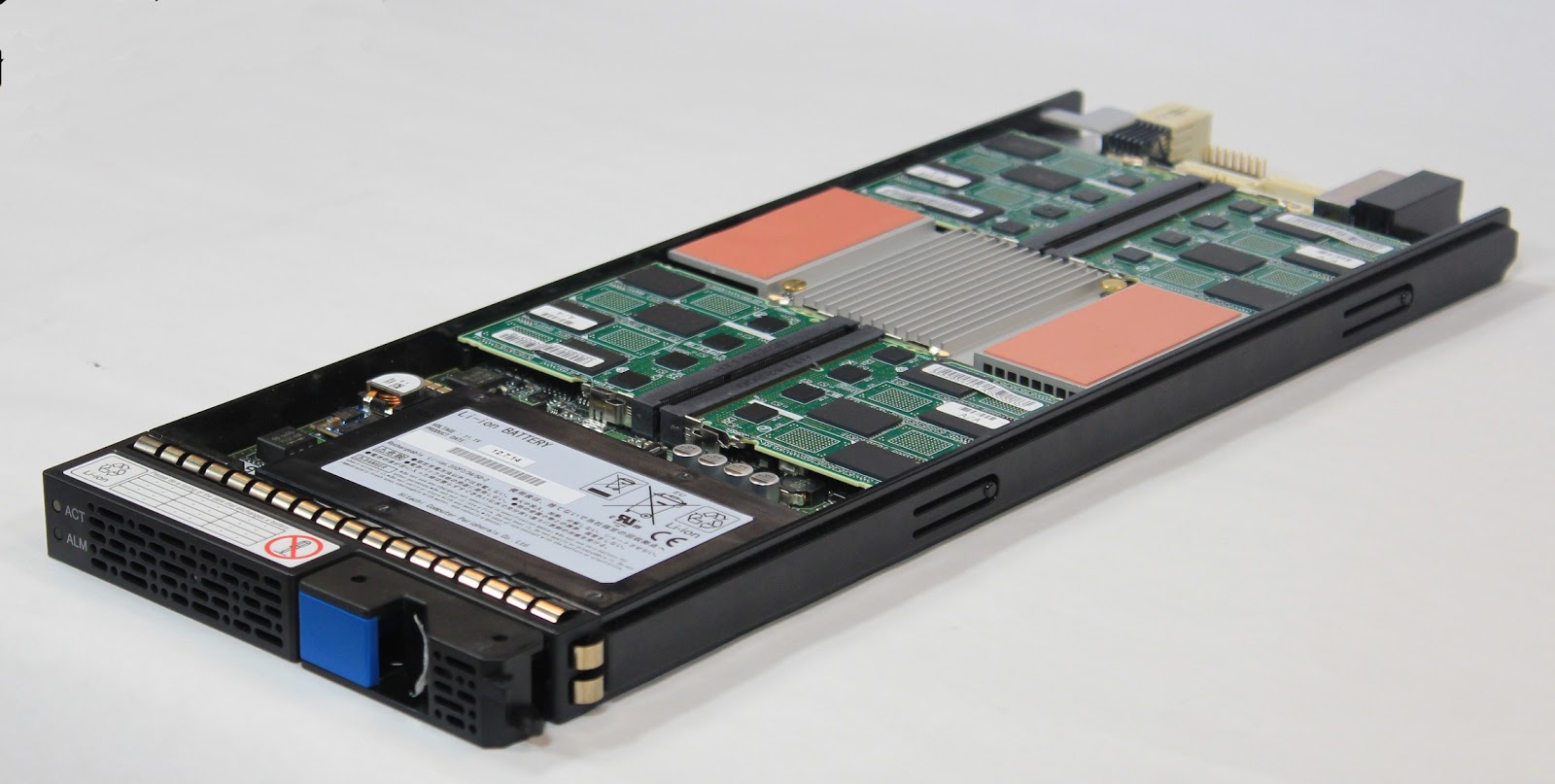 |
| Hitachi Accelerated Flash Storage module |
Hitachi’s Accelerated Flash Storage is the first product to incorporate its new flash memory controller and could potentially cost 4x more than high-end HDDs compared to 10x. Hu said that by 2015, the price gap could narrow to maybe only 2x more, as capacities increase.
Hu’s blog explains in more detail about what this new offering is able to do.
Ovum’s Tim Stammers struck the nail on the head and probably echoed what every other analyst organisation is forecasting when he said, “The amount of data stored by organisations is increasing. This growth, both in terms of the hardware capacity required and the drain on resources, will continue to force storage on to the investment agenda and will retuire IT management to look at new technology and approaches.
“Data storage can no longer be ignored or put on the backburner by simply buying more capacity. In 2013, organisations need to address the growing disparity between storage capabilities and the requirement for greater capacity and flexibility.”