Join our community and be part of the conversation.
To subscribe, simply enter your email address on our website or click the subscribe button below. Don't worry, we respect your privacy and won't spam your inbox. Your information is safe with us.
By Brandon Teoh According to Symantec, 99% of organisations in Malaysia are at least discussing cloud, an increase from 70% about a year ago.
“A majority of businesses in Malaysia are at least discussing cloud as it has benefits of improving agility and reducing costs are clear. However, in a rush to implement cloud, there are a host of hidden costs unwary organisations may face. The hidden costs of cloud implementation can negate the benefits if not properly contained,” said Nigel Tan, director of Systems Engineering at Symantec Malaysia.
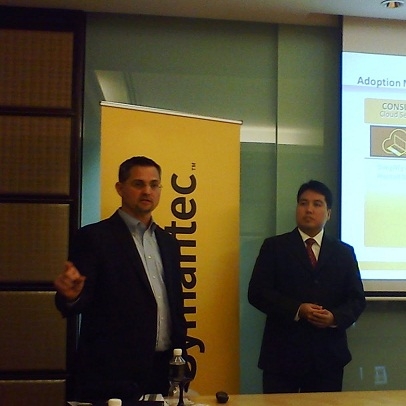
(L-R) Dave Elliott, Global Product Marketing and Nigel Tan, Director, Systems Engineering, Symantec Corporation
Symantec opines that there are essentially 3 adoption approaches towards a safe and secure cloud. Each approach is characterised by a distinct objective for cloud adoption. -Consuming cloud services – make use of available hosted cloud services to simplify IT -Extending IT into the cloud – integrating self-managed non-cloud services with public hosted cloud services -Build cloud services – build out own cloud infrastructures End users must be set clear a vision for cloud adoption in order to fully reap the benefits of cloud computing adoption. Failure to do so may result in deviation from technology and business objectives as well as incur extra costs. To facilitate further discussion, Symantec took the initiative to perform a global survey across 29 countries covering 3,236 global organisations to investigate hidden costs of cloud computing. The survey found many insightful indications pertaining to these hidden costs. Amongst them, is the key finding is that as many as 95% of adoption have witnessed rogue cloud issues over a period of 12 months. Them ‘pesky’ rogue clouds Rogue cloud refers to organisations’ business units like departments or project teams, that proceed to consume public hosted cloud services such as emails and cloud storage, as resources for daily operations without formal approval from internal IT per se. This gives rise to a state known as shadow IT adoption. It can also be associated to the consumerisation of IT trend – consumers leveraging on consumer-level computing resources to power business operations within an enterprise IT context. Rogue cloud issues c be related to security, disaster recovery, data protection and so on, Other key findings: -83% have experienced a recovery failure in the cloud. -83% goes to waste as only 17% of cloud storage is actively being utilised globally. -As much as 71% of cloud computing platforms are attempting to prove compliance with requirements. -55% of information archived in the cloud is not properly indexed and hence not searchable.
In retrospect to all these hidden costs of cloud computing adoption, Symantec provides the following recommendations for mitigation: -Focus on policies on information and people, not technologies or platforms -Educate, monitor and enforce policies -Embrace tools that are platform agnostic -Deduplicate data in the cloud In conclusion, I would like to borrow Symantec’s cloud vision that a cloud computing platform should inherit the following characteristics: -High Availability -Secure -Recoverable -Compliant -Agile -Affordable “Wherever companies go with clouds, we will provide the protection and control they need across public and private cloud environments. Symantec’s vision is for safe, agile and efficient clouds. In 5 years, companies will operate in a converged IT world of cloud, virtualisation and mobile computing where clouds are safe. IT organisations will have better visibility, control and compliance across their private and public clouds,” said Dave Elliott. Dave Elliot is responsible for Global Cloud Marketing at Symantec. In this role, he drives market strategy for security and availability solutions from Symantec designed to help companies that build or use cloud services. Elliot was an early advocate of cloud computing while at Sun Microsystems in the 1990s.