Dell supported the landing of NASA’s new Mars rover, the most complicated portion of the mission, with data analysis conducted in two NASA High Performance Computing (HPC) clusters running Dell PowerEdge servers. Managed by NASA’s Jet Propulsion Laboratory (JPL) in Pasadena, California, the Mars rover, Curiosity, is the largest rover ever sent to explore the Red Planet.
Launched on Nov. 26, 2011, Curiosity landed on the Red Planet at 10:32 p.m. Pacific Daylight Time on Aug. 5, 2012 near the base of a mountain inside the Gale Crater near the Martian equator. Researchers plan to use Curiosity to study the mountain’s layers which hold evidence about the wet environments of early Mars and may hold clues about whether the planet ever offered conditions favorable for life. The rolling laboratory will search for two things: environments where life might have existed, and the capacity of those environments to preserve evidence of past life.
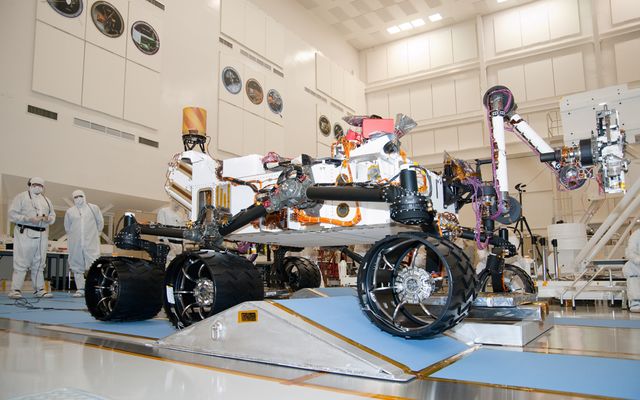
JPL’s Dell HPC clusters, Galaxy and Nebula, provided vital support to NASA’s Curiosity rover in analyzing the vast amounts of test data needed to correctly prepare the rover for entering the Martian atmosphere and landing it on the planet. This difficult task was powered by Dell PowerEdge servers that make up the Galaxy and Nebula clusters. The final landing sequence parameters developed by the mission team, which was tested and validated using the Dell HPC clusters, were uploaded last week to Curiosity.
The rover traveled a total distance of 560 million km from Earth to Mars and took 8 months 10 days 2 hours 30 minutes approximately.
The core objective of this robotic mission is to explore the habitability of Mars. The rover is equiped with most advanced technology which is capable of analyzing samples scooped from the soil and drilled from rocks.
The rover carries a radioisotope power system that generates electricity from the heat of plutonium’s radioactive decay. This power source gives the mission an operating lifespan on Mars’ surface of a full martian year (687 Earth days) or more, while also providing significantly greater mobility and operational flexibility, enhanced science payload capability, and exploration of a much larger range of latitudes and altitudes than was possible on previous missions to Mars.