


By Cat Yong
Any journo who has been following the cloud computing beat long enough, would have come across tech vendors who (try to) offer full stacks of cloud solutions to customers. It takes the thinking out of having to choose a vendor for networking, storage, and compute servers, the three fundamental hardware infrastructure needed to make up a basic but end-to-end cloud solution stack. It also takes the headache out of ensuring vendor A would work with vendor B and vendor C and vice versa and etcetera. A Gartner analyst had once said vendors need to be able to offer that at the very least, if they want to have any hope of starting a cloud deployment discussion with a potential customer.
The ones who do not have a full cloud stack, pooh pooh the ones who do, saying that customers prefer choice and that customers’ IT environments have never been based upon just a single vendor. Others decide to team up or acquire companies, to complement what they already have and even offer pre-configured reference architectures to make it easier for quick cloud deployment.
The vendors who do have full cloud stack, will profess that they work closely with the other solution providers and offer certification as a guarantee of interoperability. A few have ‘confessed’ that using their whole solution instead of just parts of it, will be better as their hardware and software are optimised for each other.
So you can imagine the scepticism (if you have been following the beat) when Oracle’s Open World theme for 2012 claimed, “Hardware and Software Engineered to Work Together.”
How different is Oracle’s ‘pre-integrated systems’ proposition compared to the other vendors who have the ‘same’ offerings and the ‘same’ mantra?
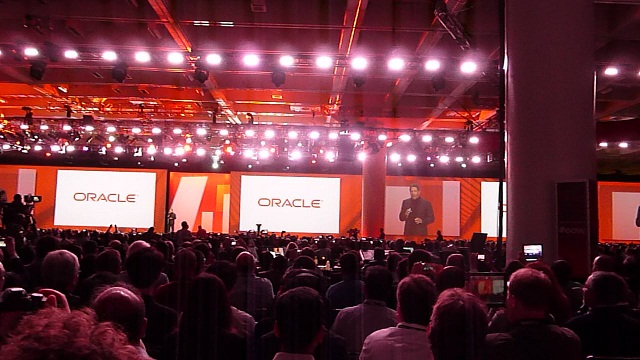 |
| A view of the first day keynote at Moscone North, Hall D |
During the first keynote just some hours ago, CEO Larry Ellison didn’t just echo the theme over and over again, as some execs are wont to do. He explained the rationale behind the bold theme instead. “Oracle happens to be the most popular database, middleware, programming language ie. Java … and we enhanced these and made it support our new cloud computing offering and Fusion applications.”
But what is going to really convince the most hardened of cynics? The triple-digit growth from last year?
What will it take?
Some other burning questions include : what customer enjoys vendor lock-in? If none, then are there really no other viable alternatives? Among its other three rivals which have similar offerings, Oracle is the last to announce an IaaS solution – how will this eventually play out?
Ellison also put on his salesman hat on stage and recommended that his higher-performance ‘engineered systems’ replace rival systems – but if Oracle produces its own end-to-end from operating system, to storage, server, virtual machines and so on – how well would it play with the rest of a customer’s IT environment?
Like I said… Burning Questions.
There is at least another 48 hours of more detailed briefings and meetings with partners and customers to happen. We shall see what more is uncovered over the next few days.
(Enterprise IT News is in San Francisco as a guest of Oracle’s to their annual Oracle Open World 2012)