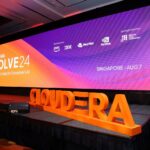

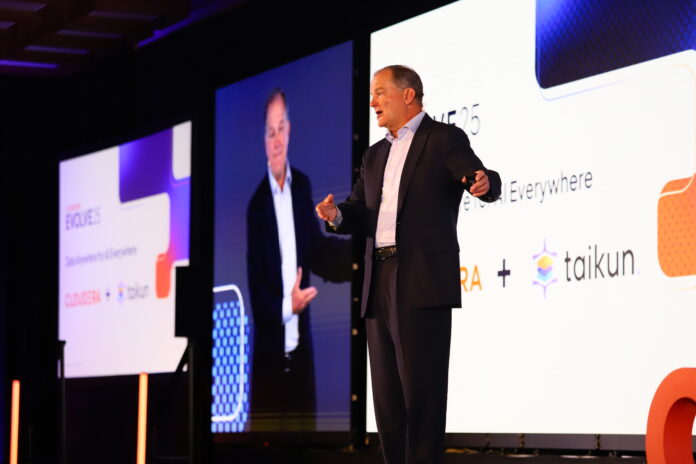
During Cloudera’s Singapore edition of EVOLVE25, CEO Charles Sansbury stated,
“A year ago, we spoke about the concept of cloud anywhere, ensuring the right workload is on the right platform, comprehensive data management and governance for the entire data estate, and the development of AI and ML applications, all encompassed within the framework of security and scalability that Cloudera is known for.”

He also emphasised that the organisation is not only growing profitably but is making significant investments in its product suite. In fact, Cloudera has invested over USD 300 million in product improvements over the past 12 months and will continue investing further.
In subsequent interviews, he and his leadership team provided more detail on what these developments entail.
This included an informative discussion with Venkat Rajaji, SVP of Product Management, and Sergio Gago, CTO.
Data services 2.0
Sergio highlighted that Cloudera’s Data Services 2.0 moved into Alpha version swiftly, thanks to the integration of Octopai and Taikun during the acquisition process. “The second half of the year will see lighthouse clients and early adopters trialling a technical preview or private beta of Data Services 2.0,” he explained.

“We want to ensure that, at an enterprise level – given the volume, size, and scale of our customers – we co-design this with organisations in key industries such as finance and pharmaceuticals, before launching it for general availability next year.”
Venkat further noted that Cloudera’s accelerated product strategy is shaped by numerous conversations with its customers.
“The feedback from our customers was very consistent – we needed to enable their heterogeneous ecosystem, encompassing data, compute, and AI. It was exceptionally clear.
We want to ensure that, at an enterprise level – given the volume, size, and scale of our customers – we co-design this with organisations in key industries such as finance and pharmaceuticals, before launching it for general availability next year.
Sergio Gago
“We knew exactly what needed to be done, which types of companies to acquire, and precisely what we needed to build from a product perspective.”
Orchestrating the entire data estate
Venkat observed, “With the Taikun acquisition, Cloudera can offer a cloud-native experience for your data, wherever it resides, to power AI everywhere.”
Taikun provides a central control plane for deploying containerised analytics workloads, such as Trino, on any infrastructure.

“It’s a straightforward statement, but what excites me is that we have now enabled interoperability across cloud computing ecosystems – you can run workloads in the public cloud, private cloud, and external Kubernetes services,” Venkat added.
This means Cloudera now has the capability to orchestrate the entire computing layer in a truly heterogeneous way. The organisation also delivers complete orchestration of a business’s entire data estate, whether integrated with the Cloudera stack or not. This is supported by increased visibility and governance of the data estate, thanks to Cloudera’s acquisition of Octopai.
Cloudera has a responsibility to orchestrate and enable this ecosystem for its customers.
Venkat Rajaji
Moreover, Cloudera has resolved interfacing challenges with its ‘catalogue of catalogues’, enabling third-party engines to directly query data against Cloudera’s Iceberg tables. Data can now be accessed and processed by various tools and platforms outside Cloudera’s own ecosystem, facilitating interoperability and orchestration across the entire data estate.
Another notable capability arises from Trino, a fast, distributed SQL query engine. Cloudera leverages Trino to deliver unified, rapid, and scalable analytics across any infrastructure, enabling a cloud-native experience that supports modern, secure, and flexible data operations, from edge to AI.
This interoperability is crucial, as businesses cannot build AI initiatives using only one vendor. Venkat commented, “It’s an entire ecosystem, isn’t it? And Cloudera AI – especially now that we have our inference service deliverable on-premises -fully enables the heterogeneous AI ecosystem that our customers may have.
“It’s a complex ecosystem to support,” Venkat concluded, noting that Cloudera has a responsibility to orchestrate and enable this ecosystem for its customers, since “…the vast majority of the data they are operating and processing lives inside Cloudera.”