

By Ayesha Jayasinghe
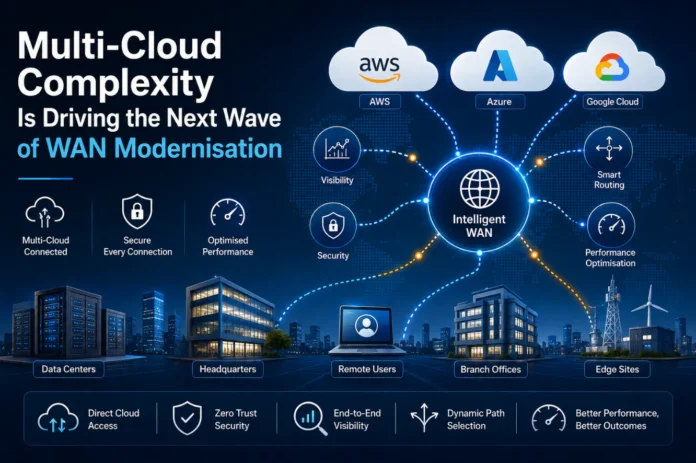
Enterprise cloud strategy has entered a new phase. Most organisations are no longer operating inside a single cloud ecosystem. Instead, workloads are distributed across multiple public cloud platforms to improve flexibility, scalability, resilience, and regional availability. For many enterprises, AWS may support analytics and infrastructure workloads, while Microsoft Azure handles enterprise productivity environments, and Google Cloud powers data-intensive applications and AI services.
This shift is fundamentally changing enterprise traffic patterns.

Traditional WAN environments were designed around predictable connectivity between branch offices and centralised data centres.
In recent times however, enterprise traffic flows dynamically across public clouds, SaaS platforms, remote users, edge locations, and AI-driven systems. Applications no longer sit inside one controlled environment, and users no longer operate exclusively from corporate offices.
As a result, enterprises are rebuilding WAN architecture around cloud-native operations rather than traditional branch connectivity.
Multi-cloud expansion reshapes enterprise traffic patterns
Multi-cloud adoption has accelerated because enterprises increasingly want freedom in how they deploy applications and manage infrastructure. Organisations are also seeking to avoid dependency on a single provider while improving disaster recovery, compliance management, and operational resilience.
However, the operational complexity of multi-cloud networking is becoming more difficult to manage at scale.
Enterprise applications now generate traffic across multiple cloud providers simultaneously. Data moves between cloud workloads, SaaS platforms, edge systems, remote employees, and connected devices in real time. These environments create highly distributed traffic patterns that traditional WAN infrastructure was never designed to support efficiently.
According to Cisco’s networking and cloud research, enterprise traffic continues shifting toward cloud-centric environments, increasing pressure on visibility, performance optimisation, and secure connectivity across distributed operations.
This evolution is forcing enterprises to rethink how traffic is routed, monitored, secured, and prioritised across increasingly fragmented digital ecosystems.
Why traditional WAN models are struggling
Legacy WAN environments were built around centralised routing and perimeter-based security models. In cloud-first operations, these architectures often introduce latency, operational inefficiencies, and limited visibility.
In modern enterprise environments, poor visibility directly affects troubleshooting, security enforcement, performance optimisation, and operational resilience.
Backhauling traffic through corporate data centres before reaching cloud applications affects application responsiveness and user experience, particularly for collaboration platforms, real-time analytics, and cloud-native business applications. As enterprises expand globally, these delays become even more noticeable across distributed workforces and customer-facing digital services.
At the same time, infrastructure teams often struggle with fragmented visibility between cloud providers. Monitoring tools may provide insight into performance within one environment while offering limited intelligence across inter-cloud traffic flows and distributed workloads.
This lack of end-to-end visibility is becoming a major operational concern for CIOs and network teams. In modern enterprise environments, poor visibility directly affects troubleshooting, security enforcement, performance optimisation, and operational resilience.
The WAN is no longer operating in a static environment where traffic follows predictable routes. It must now support dynamic application behaviour across multiple cloud ecosystems simultaneously.
Cloud-native WAN architecture becomes a strategic priority
To address these challenges, enterprises are accelerating investment in cloud-native WAN architecture built around SD-WAN and SASE frameworks.
Unlike traditional WAN models that rely heavily on fixed routing paths, SD-WAN enables application-aware traffic management. Networks can dynamically optimise traffic based on application requirements, network conditions, and user demand. This improves performance for cloud applications while helping organisations reduce operational complexity.
SASE expands this approach by integrating networking and security into a unified cloud-delivered architecture. Rather than depending entirely on centralised security inspection, enterprises are moving security enforcement closer to users, workloads, and cloud environments themselves.
Research from Cloudflare’s connectivity platform insights highlights how enterprises are prioritising secure edge connectivity, direct cloud access, and real-time traffic visibility as part of broader network modernisation strategies.
This marks a significant transition in enterprise infrastructure design. The WAN is no longer simply transporting traffic between locations. It is becoming an orchestration layer managing cloud connectivity, application delivery, policy enforcement, and operational intelligence across distributed environments.
Visibility and inter-cloud security become critical
As enterprises operate across multiple cloud environments, networking and security are becoming increasingly interconnected.
Applications, users, and workloads now move continuously between public clouds, SaaS environments, remote endpoints, and edge infrastructure. Maintaining consistent security policies across these environments is becoming far more difficult using fragmented tools and isolated network controls.
Infrastructure teams now require real-time insight into application performance, traffic behaviour, user experience, and security posture across every environment connected to the enterprise network.
This is accelerating adoption of Zero Trust access models, identity-driven policy management, and cloud-delivered security frameworks that can operate consistently across distributed infrastructure.
According to Gartner’s SASE framework research, enterprises are increasingly converging networking and security capabilities to improve operational consistency and reduce complexity across cloud-first environments.
At the same time, visibility is emerging as one of the most important priorities in WAN modernisation. Infrastructure teams now require real-time insight into application performance, traffic behaviour, user experience, and security posture across every environment connected to the enterprise network.
WAN modernisation becomes a business strategy
WAN transformation is no longer viewed simply as a networking upgrade. It is becoming a strategic foundation for cloud operations, workforce distribution, AI-driven systems, and digital resilience.
Enterprise environments are becoming more distributed, increasing the need for consistent application performance, secure connectivity, and operational visibility across multiple cloud platforms. Modern WAN architecture is evolving beyond connectivity into a foundation for resilient and intelligent operations.
Faster connectivity cannot be the only metric for modern networking. It has to also take into account how effectively organisations can orchestrate performance, visibility, and security across increasingly complex cloud environments.